
Father of the Man
Beowulf Sheehan
Reviewed by Holden Schmale
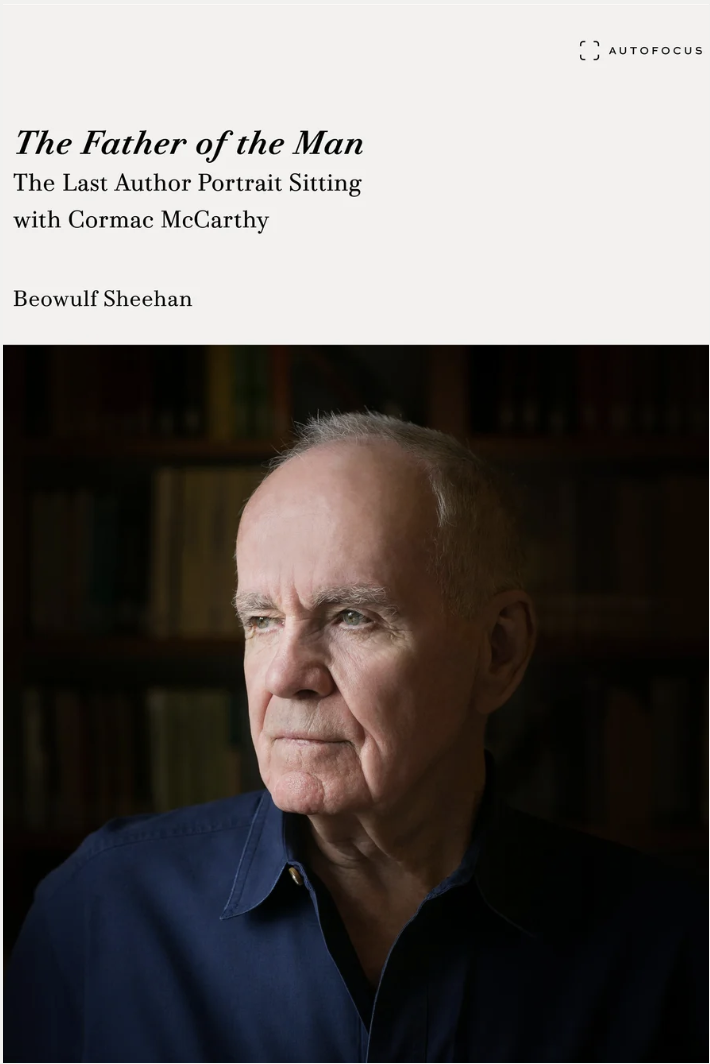
Front cover of The Father of the Man
During my first semester of grad school, a friend and I ventured to read Blood Meridian, to meet bi-weekly and discuss its themes, to work out its long, winding sentences. We are in Arkansas, not so far from the landscapes conjured up in the novel’s pages. Quickly, we both realized the sessions would be, more than anything, discussions of a shared awe at the genius who had written this masterpiece. The mind that had created Blood Meridian felt unknowable, other-worldly.
McCarthy often elicits this reaction in the literary community, a general amazement at the density of his sentences, and the scope of his imagination, the intensity of his themes and characters. At a Southwest Review reading in Dallas that I attended earlier this year, stickers that read “They Should Never Make a Movie of BLOOD MERIDIAN Or The Evening Redness in the West” were handed out to attendees, as if to say, “stay away, Hollywood, he’s ours.”
I went into reading Beowulf Sheehan’s The Father of the Man: The Last Author Portrait of Cormac McCarthy with these preconceived notions of a literary master. What I found was quite different; a personal, delicate retelling of two conversations that Sheehan had with McCarthy, not just as the legendary writer, but as a man.
Sheehan, an accomplished photographer whose work includes photographing over 1,000 writers and has appeared everywhere from The New Yorker to Vogue, lets us inside of his mind as he prepares to meet with McCarthy, then takes us along for the meeting. I was particularly struck by the introspective tone of Sheehan’s prose, examining his own life in conjuncture with his examination of McCarthy’s, using clear, direct sentences. In a moment that stuck with me, Sheehan says, “At this stage of my life, I find that every book I read has something in it that speaks to my life and, therefore, to me.” He is not only interested in helping us understand his preparation and execution with the technical aspects of the shoot, but with his personal connection to McCarthy’s work. Knowing that Sheehan is a photographer, I was unsure what to expect from his prose, but I found myself struck by the honesty and sharpness. He clearly approached this task with a deep respect for the place McCarthy holds in so many reader’s hearts – a lesser creative than Sheehan might have focused solely on the work behind the camera – but Sheehan finds common ground to tie his relationship with his father and his brother to McCarthy and the project as a whole in such a way that I left feeling not only a deeper appreciation for McCarthy as an artist, but for Sheehan as well.
The Father of the Man is a quick read, an experience meant to be had in one sitting, and no page space is wasted on fluff or bloat. The book’s eighty pages dance back and forth between Sheehan’s own prose, the photos of McCarthy, and quotes. We are dropped in right at the beginning of the process, Sheehan on the phone with Binky Urban, McCarthy’s agent, and by the time we are treated to the photos that are borne of their meeting, it truly feels like we were present for their capture. When talking with an old professor about what I’d read that semester, he replied to Blood Meridian with “that one is a full body experience.” I would say the same about The Father of the Man, a terrific mix of the intellectual, the personal, the visual, and the emotional.
The connections that Sheehan draws between his own life and McCarthy’s are a welcome reminder of just how important art is for our ability to process the things that happen to us, as well as a reminder that behind each great piece of art is a human being – something that has been challenged in recent years with the rise of AI and non-human writing. As Sheehan’s brother notes over the phone in The Father of the Man, for as many people that loved McCarthy’s work, and for the immense success he had, plenty of people loved Cormac McCarthy, the man. The way Sheehan has captured that in this book is an accomplishment to be celebrated, and more importantly, to be read.