
interview by Jace Einfeldt

photo by Claire Christoff
It was spring of 2022. I was working as a sales clerk at Books End, the oldest operating used, rare, and out-of-print bookstore in Syracuse, NY. I was also working as the fiction editor for Soft Union and was soliciting work from dozens of different writers. I had reached out to Ashleigh Bryant Phillips, author of the story collection Sleepovers (2020, Hub City), to solicit a story, and in response she sent me a list of writers to read and reach out to that included, among others, Gray Wolfe LaJoie, Daisuke Shen, Raegan Bird, and Nathan Dragon. She turned me more directly toward Joyland where she had been the editor for the American South region of the magazine. On my lunch breaks, I read through the list of writers that Ashleigh had sent to me as well as Joyland’s more recent publications. I happened upon a story by a writer named Drew Buxton titled “Lexapro”. At the old card table in the break room of Books End, I took off my KN95 mask, unwrapped my PB&J, read “Lexapro” on my phone, and was immediately taken in by Buxton’s writing. I was enamored by the humanity of his characters, the savage humor of his work, and the strangeness of his characters’ lives and predicaments.
I immediately read every story of his I could find online–among them, ”Burl”, published in X-R-A-Y and “Riot”, published Vol. 1 Brooklyn–and solicited a story from him for Soft Union. Unfortunately for me, Buxton’s fiction is a hot commodity, and the story he sent to me was picked up somewhere else. I tried again a couple years later with the same result. Over the last four and a half years, I have been following Drew Buxton’s writing and devoutly reading everything he has published, and you should do the same!
What follows is adapted from a conversation Drew Buxton and I had over the phone in late July 2026. In our conversation we talk, among many other topics, about his debut novel Daytona Teddy Riggs, Gabe Habash’s criminally underrated novel Stephen Florida, Charles Portis, Barry Hannah, cringe comedy, and Buxton’s love for film noir.
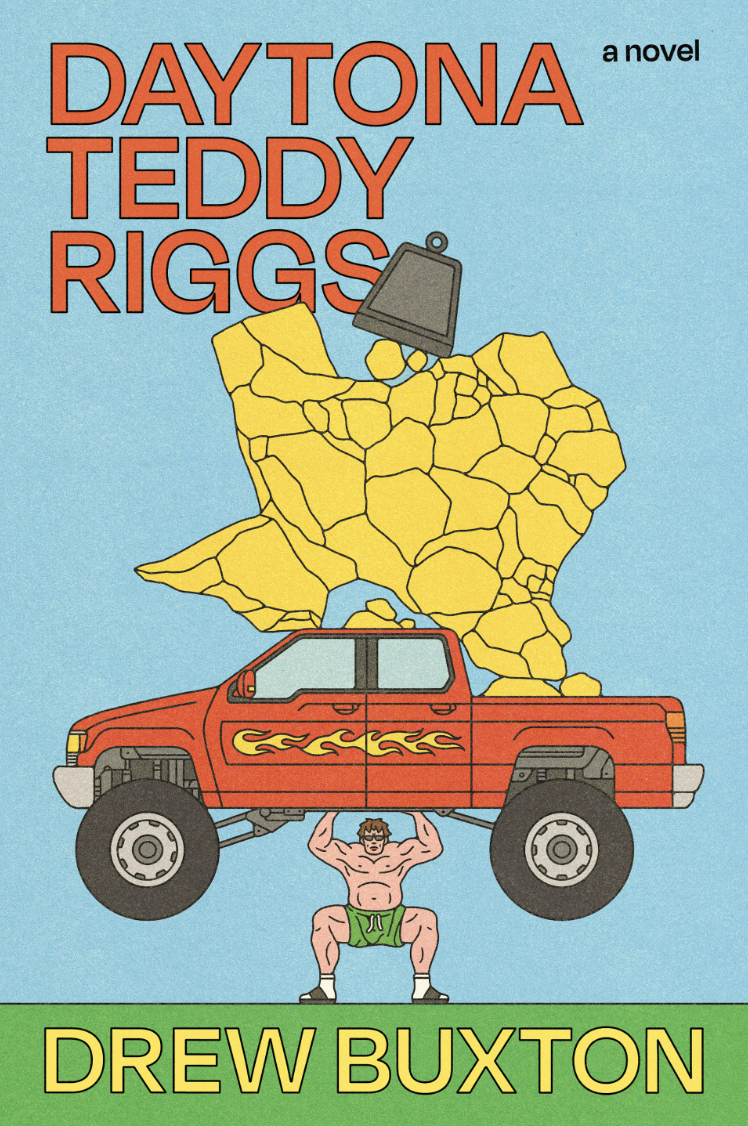
Cover of Daytona Teddy Riggs
Jace Einfeldt: Daytona Teddy Riggs has already gotten some pretty stellar reviews. In William Boyle’s review, he makes comparisons to Harry Crews, Charles Portis, and Barry Hannah. Harris Lahti calls Daytona Teddy Riggs a “‘roided out Ignatius Reilly, a fast-food obsessed Holden Caulfield, a madcap Joe Lon [Mackey].” How do you feel about these comparisons with the book making its way into the world?
Drew Buxton: I mean, it’s honestly really flattering. I read Harry Crew’s The Gospel Singer a few years ago, and that was pretty mind-blowing. With Charles Portis, I realized there was actually a large hole in my reading for a long time. After that, I told myself that I finally just need to read him. I actually just read Dog of the South and was really blown away. It’s one of the funniest books I’ve ever read. I’m kind of jealous of some of the things he does. There’s an effortlessness to the humor. One of the things I’ve talked about with my friend, Chris Vanjonak, is that the humor needs to be kept within the world that you’re working in, and it has to make sense. You need to avoid what Chris and I call “selling out” for the bit. Going for a laugh that ultimately compromises the scene or is out of character. Portis is so within the world he has created. It feels so natural. So, yes, with those comparisons, I feel like I definitely fall within the category of Southern literature. I associate Southern writing more with a spare style, and that’s something that I have always preferred. It’s how I naturally write. The same goes for Harris’s comparisons to Ignatius Reilly. [A Confederacy of Dunces] is another one of the funniest books I’ve ever read. It’s kind of surreal to have writers I really admire, like William Boyle, compare me to these legendary writers.
JE: Yeah, it kind of makes you want to tear up a little bit. You kind of feel like you’ve made it a little bit, right? Like you’re on the same level as these writers. In addition to Crews and Portis, who are some of the writers you looked to as you conceived of and began drafting Daytona Teddy Riggs?
DB: One writer who I think of in the same league is Mary Miller. She has been really influential on me. She’s actually someone who helped me with my first book and went out of her way to help me when I felt like I really didn’t have anything to offer. Another book that came to mind while I was working on this book was Stephen Florida by Gabe Habash.
JE: Oh my gosh, yeah.
DB: It’s about this obsessive collegiate wrestler. I love how committed Habash was to this character. There’s a simplicity to it. He has this objective, this goal. He wants to win the national title, so we’re moving towards that. The story has a natural propulsion that kind of allows Habash to explore the character in some really cool ways. The tone is much different than Daytona Teddy Riggs. It’s much more serious. The character is more serious. I was inspired by the surface-level plot that was simple but also compelling. Stephen Florida and Daytona both have that obsession that’s pushing them through the book.
JE: I’m glad you brought up Stephen Florida. I honestly think about that book all the time. I’m frustrated that more people haven’t read it because it’s such an underrated novel. I’m always trying to get people to read it.
DB: Yeah, I don’t know if I’ve met anyone who, when I’ve brought it up in conversation, has been like, “Yeah, I’ve read that book.”
JE: To your point about the tone differences between Stephen Florida and Daytona Teddy Riggs, one of the things that I appreciate the most about Daytona as a character is that he is, at least to an extent, self-aware. He knows in some way that he’s putting himself in situations where his obsession, his desire, and actions toward fulfilling those desires will rub up against situational and even societal expectations. You’ve talked about, in other interviews, that you are obsessed with characters that are delusional. They’re destined to fail miserably. You’ve said that there’s a lot of natural comedy with characters like this because they are both confident and dumb. Despite Daytona Teddy Riggs’ obvious flaws and bullheadedness, I found myself rooting for him. Why do you think we are so drawn to these types of characters? And why do you find yourself gravitating toward characters like Daytona Teddy Riggs?
DB: I feel like right now, there’s this huge discussion about likeable versus unlikable characters. The unhinged narrator. I enjoy that, but what I do find frustrating is there are a lot of first-person narrators that are doing all these crazy things and seem to be fully aware, maybe too self-aware, of what they are doing and why. When people do crazy things, I often think there’s a real rationale behind it in their minds that others can’t truly understand. As the reader, you can triangulate the world’s reaction to characters like Teddy through this rationale even though they aren’t super aware of the effect their choices have on the people around them. With Teddy being likeable, I think it’s because he’s pretty child-like. We are more forgiving of child-like characters. I think we’d be less forgiving of his behavior if he were smarter and more calculating. With people like Teddy that I’ve known, or who fit this particular stereotype, I’m always looking for something to like about them. I’m looking for some good, something that’s surprising, or some reflection. There’s something about the reflective, internal moments Teddy has when he’s struggling or when he has these full-on breakdowns that forces us to be with him, to see him how he sees himself and see the good parts of him through his eyes. The book is like an empathy machine. As we follow Teddy around eventually we’ll start pulling for him.
JE: You definitely put the narrative mechanisms in place to allow for readers to empathize with Teddy. It can be really easy really throw characters like Teddy through the ringer and just let them suffer because they, for lack of a better way to say it, seem to be really good at or maybe even more susceptible to putting themselves in awkward, cringy, tense, and oftentimes ethically precarious social situations. You let Teddy be himself despite his predilection toward self-sabotage, but you never once make him the butt of the joke. The situations Teddy finds himself in are often hilarious because of how Teddy doubles down on his decisions in the face of obvious social mores that he is very clearly transgressing. Honestly, I couldn’t help but think of Teddy as a character out of an I Think You Should Leave sketch. With this in mind, what influence has cringe comedy had on your writing?
DB: I definitely think it has. Basically, from the beginning with Tim & Eric I’ve been a fan of this kind of comedy.
JE: Yeah, I’m thinking of moments like when Teddy gets kicked out of Jorge’s gym for picking up a weight and threatening to throw it at him and then getting super defensive once Jorge bans him from the gym. Faced with the reality of his actions, he immediately digs his heels in and is like “I’d never even think about throwing a weight at you, are you crazy?” I even see a little bit of this in the scenes of self-harm when we see Teddy cutting himself and Tammy comes in and confronts him and he’s like “It’s not what you think it is. This is actually good for me. It makes me feel good.” Or when Teddy gets the crap beaten out of him by the punk he chases down in Tammy’s car. I can’t help but laugh, but it’s the kind of laughing that comes out when no other reaction seems appropriate to the situation.
DB: I do think that type of humor likes to highlight the darker moments in characters’ lives. When I’m going through a hard time or dark times in my past, I associate those moments with humor. They’re kind of linked in my mind. There’s humor to be found in the pitiful moments of our lives. Things can be sad and funny at the same time. Like with Teddy’s road rage incident where he gets beat up. He’s kind of justifying his loss because the other guy “fought dirty.” It’s definitely a low point for him, but it’s really funny.
JE: You said in an interview once that, in your process, you have to convincingly establish that a character is capable of doing something ridiculous at first before we arrive at the truly crazy bit. We’ve talked about how you’ve done that with the funnier moments throughout the novel, but I want to put this idea out there in the context of the darker moments. How did you approach balancing humor with darker, sadder moments in the novel? And how do you determine where those moments can most effectively land in a novel as funny as this one?
DB: There are definitely sad moments in the novel that aren’t funny. We’re in this character’s mind, and they are experiencing sadness or anger. Naturally, they look for an escape. A lot of times, Teddy’s escape is to go train if he’s upset about it. That often leads us to funny situations where he gets worked up like when he goes to the gym and puts himself in a kind of lifting competition against a guy who is obviously oblivious to Teddy competing against him because it’s all in his head.
JE: Yeah, that makes totally sense. It’s important to have these moments of escape to keep the story from being stuck on one note.
DB: Totally, yeah. Earlier with my writing, I was always inclined more toward humor. A lot of the time I found myself writing with too much humor, and I wouldn’t have these grounding scenes. More sincere moments. I always had this fear that I would lose the reader if my writing veered away from the humor toward sincerity, but those sincere scenes are the moments that actually keep readers engaged, in my experience. It’s hard to write these kinds of scenes. Scenes of personal or person-to-person confrontations. It really takes a lot of discipline to get them right.
JE: Well, that discipline definitely pays off in the novel with the more sincere, intimate scenes we get with Teddy as readers. Regarding confrontations, you’ve talked in the past about how you realized that avoiding necessary confrontations with your characters hinders the character development or the scene is doomed to fail. The novel is full of moments of necessary confrontation like Teddy steeling the St. Jude’s jar of donations from the HEB or Teddy busting into Pat’s trailer toward the end. As a writer, how do you determine whether a confrontation is ultimately necessary for the story? And were there any confrontations that felt necessary in early drafts that ended up on the cutting room floor?
DB: One thing I think about a lot is having an event quickly summarized versus shown, right? For example, in dialogue, is there something that someone says in a specific way that is going to negatively or positively impact the character and their development? Let’s look at the conversation between Teddy and his parents over the phone: if there’s something his mom says that’s said in particular way that will cause Teddy to ruminate and look at himself differently, then sitting in that phone call longer feels more necessary. If the interaction is going to fundamentally change the dynamic between characters, then that’s another reason to show a confrontation as opposed to quickly summarizing it. We know that Teddy’s parents disapprove of his lifestyle. We’re told that early on, so we don’t have to see it all the time. Seeing it once contextualizes the dynamic that Teddy has told us and provides shape and depth to the dynamic between him and his parents.
JE: A little bit of a shift here: I wanted to talk about surrealism because it’s something that plays a prominent role in your writing. You’ve described your writing as “surrealist dirty realism.” I find William Boyle comparing your work to Barry Hannah’s to be very apt when discussing your work. What is it about surrealism that interests you? And in addition to being a fun space to write in, what do you see as the narrative or character utility of surrealism in your work?
DB: I’m a massive Barry Hannah fan. I mean, used to write flat-out speculative stories that often go off into the supernatural. I’m interested in works where writers are making their own rules that make sense within the world they’ve created. Worlds that are kind of like our world but not quite. Like in the title story of my collection So Much Heart, they find D.B. Cooper’s body and his fortune. Though it’s an unlikely scenario, it’s not impossible. This kind of scenario works well with surrealism because it shows the audience that we’re making our own rules. In terms of utility, it does allow you to kind of stretch believability once you’ve established that this is not the world that we live in though it looks very similar. That’s something you have to establish fairly early on. Another example from my collection is the story “Monticello” where this kid becomes this drug kingpin of his elementary school. Believability in this story begins with this kid being precocious, and then things kind of take off from there. Once believability is established, the writer can shift the rules in a sly way. Like you said, writing in this mode is fun. It gives me a dopamine boost for sure.
JE: I really love this kind of writing because literally anything is possible. I think part of the reason I’m drawn to this kind of writing is because of the stuff I read as a kid. I really liked reading more whimsical stories because, even though it was grounded in a sort of reality, the sky was the limit. It might also be the writing space I’ve been occupying for the last several years. A lot of the writers I really admire write in this vein. They write stories about the strangeness of being a human being on a strange planet under even stranger, unpredictable circumstances.
I want to go back to Teddy for a little bit here, if that’s okay.
DB: Yeah, of course.
JE: There’s a moment during the Pat Dupree seminar when Teddy tells us that, “[i]t’s like what the Buddhists say—desire creates suffering.” It seems like this is a true statement for most of the characters you write about. Their desires create a lot of suffering in their lives and the lives of those around them. Do you believe that your characters need to suffer in order to achieve or at the very least feel like they’ve achieved their desires? What role does “suffering for desires” play in your writing?
DB: Teddy’s world, his situation is getting worse throughout the story. He gets in trouble with the law. He has pissed off his friends. Amidst all this suffering, there’s an internal arc where there’s some self-discovery going on, and I think it’s only through these types of circumstances and the consequences of his actions that Teddy can achieve the enlightenment he needs. As an All-Star Athlete in high school, Teddy likely didn’t meet much resistance to his desires. There was no real reason to change. When we meet him, he’s no longer a football star, but he still has this mentality as he runs into these different issues. In order for him to be self-aware, I think he definitely needs to suffer.
JE: I’ve definitely found myself stuck in a similar mentality as Teddy in different parts of my life. I feel like I’m up against a brick wall, and I forget that more often than not I built the brick wall out of my own hubris, my own poor decisions, and it has required a level of suffering to figure out how to get around, over, or even through the wall, as hard as that can often be. It’s hard to put your characters through those kinds of experiences, but sometimes that’s the only way for the story to happen. Without that suffering, where’s the story?
DB: Totally.
JE: You’ve talked to Mary Miller about how you feel like you’ve “used comedy as a crutch to explore horror in [your] writing.” You said that, “[You’d] love to write more pure horror in the future.” What is it about horror that calls to you as a writer?
DB: Actually, I no longer have that ambition. I’ve become a lot more interested in noir crime fiction. What I’m working on right now is heavily influenced by Rion Johnson’s debut feature Brick (2005). It’s definitely less “funny” than Daytona, which is kind of scary for me, and it’s written in the third-person. With books like Daytona, the voice of the first-person narrator can kind of carry a lot of the book. The reader engagement can often be almost built into an arresting first-person narration. For me, the third-person feels flatter. I feel like it’s going to have to take a leap of faith for me. It’s a new way of writing for me that’s going to take some time to get used to.
JE: I totally get that. It’s hard to pivot into a different mode for a different project and in a different genre as well.
DB: Yeah, maybe this shift away from horror is me being a contrarian. I’m still a huge fan. It’s just there have been so many horror movies and books that have come out in the last ten years that I feel like the field is a little saturated. I don’t know that I have anything unique to add to that genre right now. Noir, film noir, is something I’ve always been fascinated in. A lot of noirs are built around an act of petty crime that reveals something larger the more it’s investigated. There has also been this trend in noir of taking the crime out of the city, of moving the crime to unexpected places. The Coen Brothers do this. They did it with The Big Lebowski which is modeled after The Big Sleep. They take a New York crime story and move it into Los Angeles. I feel like this kind of move in noir is appealing to me because of what we talked about with surrealism: letting a sort of familiar situation play out in a different space or having a strange situation unfold in a familiar setting. I really owe a lot to the Coen brothers in this regard. The novel I’m working is built on this stash of Quaaludes in the ’80s right when they’re banned in the US that end up becoming really valuable. I just love schemes. They’re just fun to write.
JE: It’s like setting up dominoes.
DB: Right, right.
JE: To close, we’re living in some pretty dark and dire times. It can be really easy to be cynical generally and, as writers, it can be even more alluring to succumb to cynicism in our work. When it comes to writing in a more realist mode, there seems to be a trend or even an expectation to disavow “happy endings”, emotionally cathartic endings, and even straight up sentimental endings because that’s “just not how life is.” Your writing seems to be actively pushing against cynicism in a way that I find to be very refreshing. What is the motivating force behind this decision in your work?
DB: I don’t think it’s a conscious decision. The main thing is that if I felt totally cynical, I wouldn’t see any point in writing. There wouldn’t be anything interesting. When I first started writing, I was really pretentious, like a lot of young writers tend to be, and I associated darkness with depth. If it was really dark, it meant that it was good. If it wasn’t dark, it shouldn’t be taken seriously.
JE: I agree. Like, what would be the point? There would definitely be this sense of existential dread hanging over the novel that, if left unchecked, would make for a very different reading experience. For Teddy, he’s delusional and doesn’t see a reality around him where the doom of failure will ever meet him completely. In his mind, he is too big to fail and too big, at his best moments, to fall completely into despair. One of the many things I admire about this novel, without giving too much away, is that you allow Teddy to believe he can succeed, which is a lot more than most writers would do for a character like Teddy.
DB: My brother actually called me out on my early writing. He said it was just straight nihilism. It wasn’t compelling. That was a good lesson for me to learn. In the case of Daytona, if he were doomed in a way that was clear, like there was no way for him to succeed even in his mind, it just wouldn’t be as interesting.
Drew Buxton’s debut novel Daytona Teddy Riggswas released on 26 August 2026 through Hub City Press. A review of the novel by Jace Einfeldt in The Arkansas International can be found here.

Interviewee name and bio goes here.