
Errand Weather
Nathan Dragon
Reviewed by Jace Einfeldt
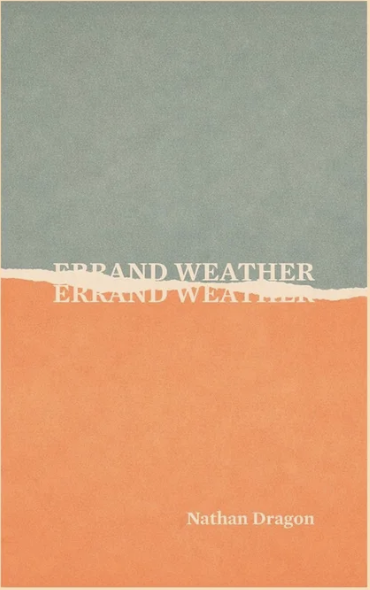
Front cover of Errand Weather
You don’t have to look long on the internet to find someone justifiably describing our current era as a “capitalist hellscape.” Everyone you know is carefully curating an existence worth ogling at while. We’re constantly pressured by algorithms to keep up with the digital Joneses while the world around us is dying, and our time and attention is being sapped by corporations who see us only as consumers. Hobbies are turned into side-hustles either out of financial necessity or out of a hunger to be acknowledged by a social machine that feeds on our fear of being forgotten. We fill every moment of our lives with activities upon activities just so we can look back on our day in the quiet minutes, or maybe seconds, we afford ourselves at night and say to ourselves and our followers that we had a good, full day. These are the moments that constitute a heaven on earth, or so we’re told. A conspicuously productive life is the good life, right?
But what if that’s not the life we have? What if that’s not the life we want? What then? Are we failures? Can we really be happy? If our lives aren’t being flooded with sound, lived loudly and livestreamed, are they really worth living?
In Nathan Dragon’s Errand Weather, he suggests the opposite is true. Errand Weather opens with an epigraph from Thomas Merton’s No Man is an Island: “If we strive to be happy by filling all the silences of life with sound, productive by turning all life's leisure into work, and real by turning all our being into doing, we will only succeed in producing a hell on earth.”
In Errand Weather, the lives of Nathan Dragon’s narrators unfold in the quiet, solitary moments. The soft, silent minutes between jobs and tasks. Catching a glimpse of the sky with all its curling clouds while driving home from work. Watching television on the couch with your dog. Walking in the autumn woods at blue hour. Holding your breath to hear the birds sing softly in the trees. Sitting on your porch observing the lives of your neighbors with your dog at your side.
In “Fug”, the first of Errand Weather’s two novellas, there’s a moment when a turkey flies over the narrator’s car while he’s driving home from a flower shop by the harbor. Sometime later, in the autumn, he’s stopped in traffic. He sees a pair of turkeys fighting or maybe mating and rolls his window down to watch, to observe, to understand. Someone behind him honks their horn, and he almost misses the light. “Sorrysorrysorry,” the narrator says, and, to himself, to the other driver, or maybe even to us, he says “but if you just look, you get to watch the turkeys a little longer.”
“Fug” consists of vignettes full of wise, hilarious, and poignant moments—many of them only a few lines long while some spread across a few pages at most—in the life of the narrator as he works, buys groceries, relaxes, spends time with his dog, and thinks about what all of it means to him and those around him. “Fug”, much like Dragon’s debut story collection, The Champ is Here, lives and thrives in the quiet, contemplative moments. Dragon revels in the humdrum and invites us to sit down with his characters and look around for a while. To drink it in. Breathe it in. To stop and smell the air the moment the sun sets after a long day of work in October and let the chill wake up our senses to what has always been there if we were just willing to slow down.
In “The Marine Biologist”, the concluding novella in Errand Weather, MB, the narrator, likewise tells himself early on to “[s]tay focused; Be aware of things.” This sentiment is at the core of Nathan Dragon’s writing. His narrators are observant and always acutely aware of their physical and metaphysical surroundings and how they exist within this space. They are fully within themselves and the world they inhabit.
The world of Nathan Dragon’s fiction is one dictated by reverence for the everyday. In Errand Weather, as is the case with everything Nathan Dragon has written, we are introduced to lives simply and humbly lived. His work is quiet and understated, yet each sentence, each phrase, each word brims with a calm beauty that is as intimate as it is universal. Every moment and every scene of a Nathan Dragon story feels lived in and incredibly embodied because he, as a writer, cares deeply about his characters and their thoughts, their fears, their ambitions, their lives.
If you were to ask any character in Nathan Dragon’s body of work what they thought heaven looked like, they would kindly lead you to the porch swing out back and hand you a beer or a cider. The two of you would sit sipping and staring out at the leaf piles raked up like shaggy haystacks against the cool gray of a late, mid-autumn Massachusetts afternoon and just listen to the squirrels chittering in the trees. The wind would rattle the neighbors’ chimes and rustle up some loose leaves across the yard. After some time, they’d turn to you and say, “You’re already here, friend, and that’s all that matters.”
Reading Errand Weather reminds me of why I love to write. It inspires me to write. It honestly fills me with awe, wonder, peace, and gratitude. Nathan Dragon has once again proven that he is an impeccable prose stylist, maybe even one of the best we have. In Errand Weather, Nathan Dragon shows us that a heaven on earth, an earth Thomas Merton would be proud of, is possible as long as we’re willing to slow down, take a deep breath, and make it so.