
Sardine
Miriam Reyes
Translated by Laura Cesarco Eglin
Reviewed by Jace Einfeldt
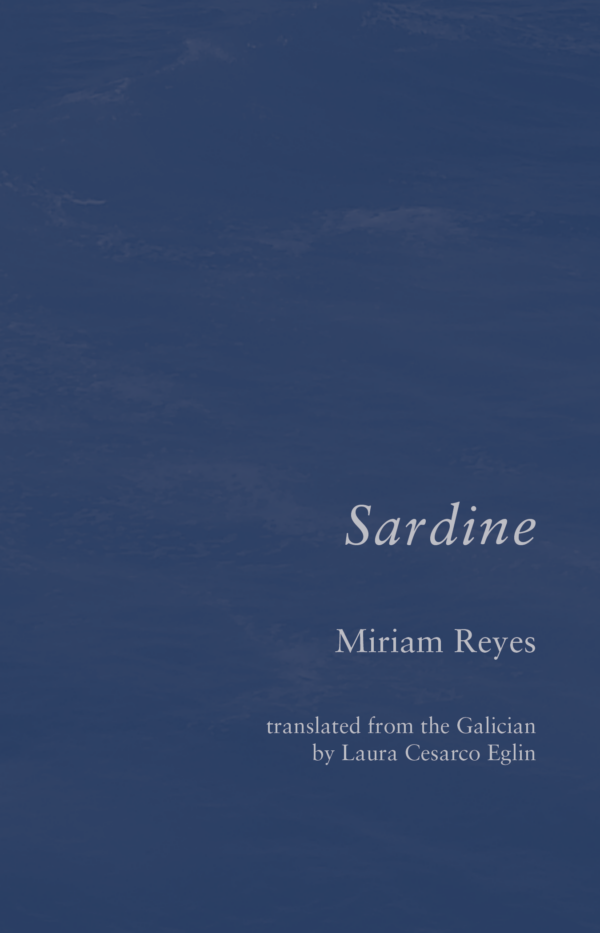
In Miriam Reyes’ Sardine, translated from the Galician by Laura Cesarco Eglin, the distance between the speaker’s language and her tongue is an ocean that separates continents, time, memory, and language itself. Reyes deftly plumbs the depths of linguistic identity to close the gap between herself, a Galician migrant to Venezuela, and her late grandfather, Reyes’ sole tie to the language of her ancestors.
Reyes and Eglin examine the frustrating limits of language in expressing loss, longing, and the desire to understand and be understood. Sardine opens with the first two lines crossed out. They are then immediately rewritten, reinvestigated, and reinterpreted. Throughout Sardine, the speaker strikes through words, phrases, whole lines as she second guesses her ability to adequately write in her grandfather’s tongue. Reyes opens the messy can of language and memory and offers readers a taste of what it means to “cross an ocean and [land] / in the middle of the night.” In this translation, Eglin invites English readers to join Reyes in reveling in the slipperiness of memory filtered through a two-fold translation: Reyes’ own grappling with Galician and Eglin’s astute and careful translation of the book into English.
Sardine’s speaker addresses the challenge of translating memory through multiple layers of language. She says, “even if i speak with difficulty, the difficulty is part of the story.” This is a story of a woman rediscovering a piece of herself left behind in migration. Reyes writes toward this story despite the frustrations of writing in a tongue that is hers by heritage yet feels foreign as it “lick[s] / what’s left of the syrup on the plate / of memory.” Reyes is pulled toward this story. She is a satellite orbiting her family and linguistic history attempting to approach a semblance of understanding.
As Reyes enters the orbit of her grandfather’s “léngoa”, she explains that “Segundo o dicionario o A é o símobolo do ampere e non de ti.” Literally translated: according to the dictionary the A is the symbol for the ampere and not for you. Reyes’ relationship to her grandfather and Galician in this moment is one charged with “a intensidad de calquera corrente de amor”: the intensity of any electric current of love. In Eglin’s rendering, this electric relationship becomes tied to the laws that govern life itself. Through Eglin, “ampere” becomes “gravity”. The “A” of “avó” and “ampere” becomes the “G” of “gravity” and “grandfather.” The “electric current of love” becomes the “pull of love.” Eglin expertly places stepping stones for English readers to walk nearly parallel with Reyes as she “jump[s] from one stone to the next” on her “journey from lingua to tongue.” While the forces governing Reyes’ journey are different across translation, the intensity of her love for her avó remains constant.
Despite its size, Sardine is a rich and tightly packed book. Reyes yearns to connect “faithfully / feasibly / feelingly / felinely / generously / oceanically” with an integral part of who she is. From the shores of Galicia and Venezuela, Reyes and Eglin beckon English readers to join them toward “a safe place / where [Reyes’ avó] can come out of [their] mouth / smoothly like a kind word.”
Sardine by Miriam Reyes (tr. Laura Cesarco Eglin), Ugly Duckling Presse