
Smoke
Gabriela Alemán
Translated by Dick Cluster
Reviewed by Masha Kurbatova
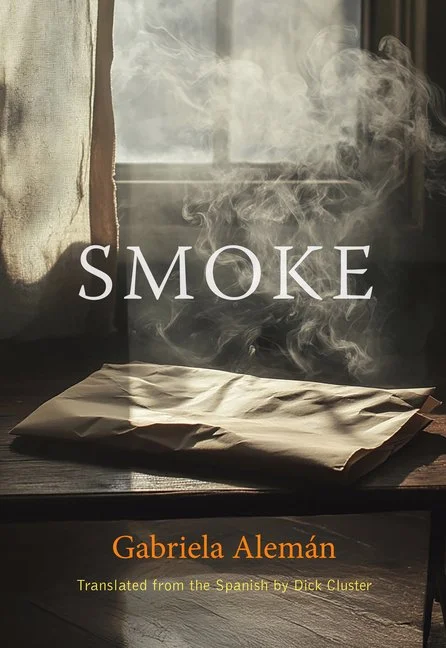
The inventor of the ball point pen. A diseased dictator. Flocks of giant, flightless birds. These are but a few key characters in Gabriela Alemán's hazy, fragmented Smoke (2025). Published by City Lights Books, this novel weaves together the past and present of Paraguay, overlaying them like translucent, cloudy paper. The book asks: who remembers history, and how? How do the personal and political intersect? And, how can a narrative interrupt itself to portray these things in all their nonlinear glory? To quote Alemán, "Being a keeper of the past is like being the guardian of white smoke..."
The author's namesake, Gabriela, opens the book. She's arrived at an old house teeming with dust and memories. The house is a familiar one, haunted by a man named Andrei and his complicated legacy. Gabriela finds Andrei's old journal, and begins reading. This is the story's second timeline, of Andrei's transatlantic journey to Argentina, to Paraguay, his presence in the nations' pivotal historic pressure points. Both time periods are told in present tense; they seem to take place simultaneously. Gabriela pieces the past together, reading and talking to people who once knew Andrei. The book fractures into small sections — told in prose and poetry and letters and officials' communiques and ripped, flying scraps of paper — as Gabriela attempts to stitch together one man's life, her presence in it, and the rippling effects of individuals' actions on global history.
On the boat from Europe, Andrei meets a second Hungarian, Ladislao Biró, an inventor, a real-life figure who popularized the modern ballpoint pen. Biró takes Andrei into the home President Agustín Justo has rented for him in Buenos Aires. Biró and a third man, Palamazczuk, tinker with preparations of the still-new penicillin. Over the years, Andrei's friendships carry him to a remote leprosarium, on perilous hunts for the ostrich-like ñandúes, to the gruesome front lines of the bloody Chaco War between Bolivia and Paraguay. Andrei's key collision with Paraguay's dictator, Stroessner, has consequences for the whole country. Stroessner is real. His crimes against his people are real too. Alemán's blend of history and fiction is thus a potent one.
Translator Dick Cluster makes careful effort to capture the mix of languages pulsing in the source text. While Smoke is written mostly in Spanish, the indigenous language of Guarani is woven throughout, as are Biró, Palamazczuk, and Andrei's native European tongues. All these languages remain in the English, yet more threads overlaid in history's tapestry.
In her investigation, Gabriela talks to a man from her past. She "looks at him and though she sees him now, what she's really seeing is how he used to be. It's not hard to do, she just has to try. It's all there. The past, the present, the future." This is how the author invites us to see place and people. It's all there, all happening at once. Smoke reminds us that history is not yet over.
Smoke by Gabriela Alemán (tr. Dick Cluster), City Lights Books