
James McWilliams
interview by Patricio Ferrari
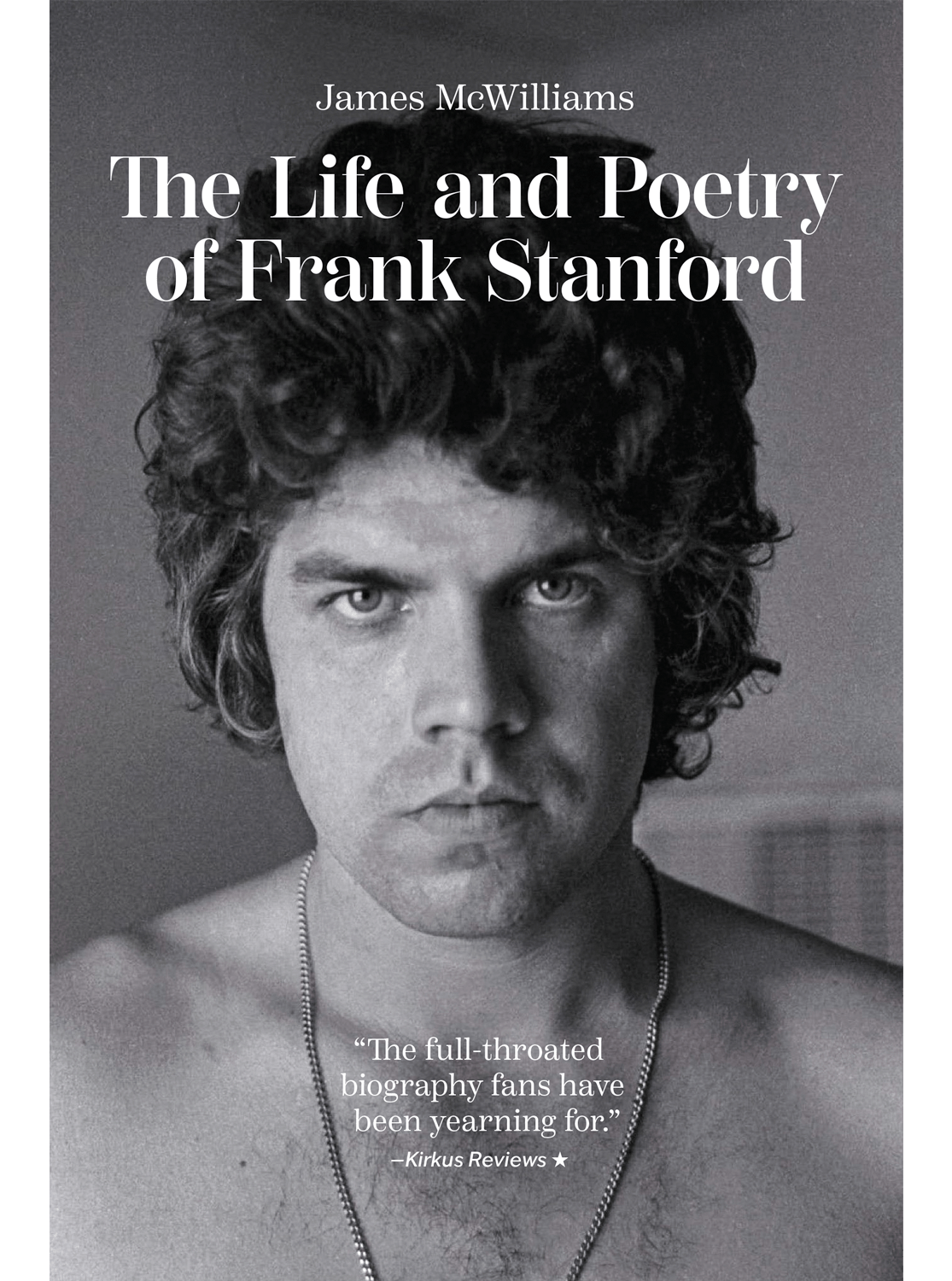
The following conversation, between James McWilliams and Patricio Ferrari, took place on November 13, 2025 at 192 Books in New York City. There, they discussed McWilliams’s biography of poet Frank Stanford, The Life and Poetry of Frank Stanford (University of Arkansas Press, 2025). The event was recorded and shared on YouTube, and transcribed by Keen Eve. Eve’s transcription has been edited slightly for length.
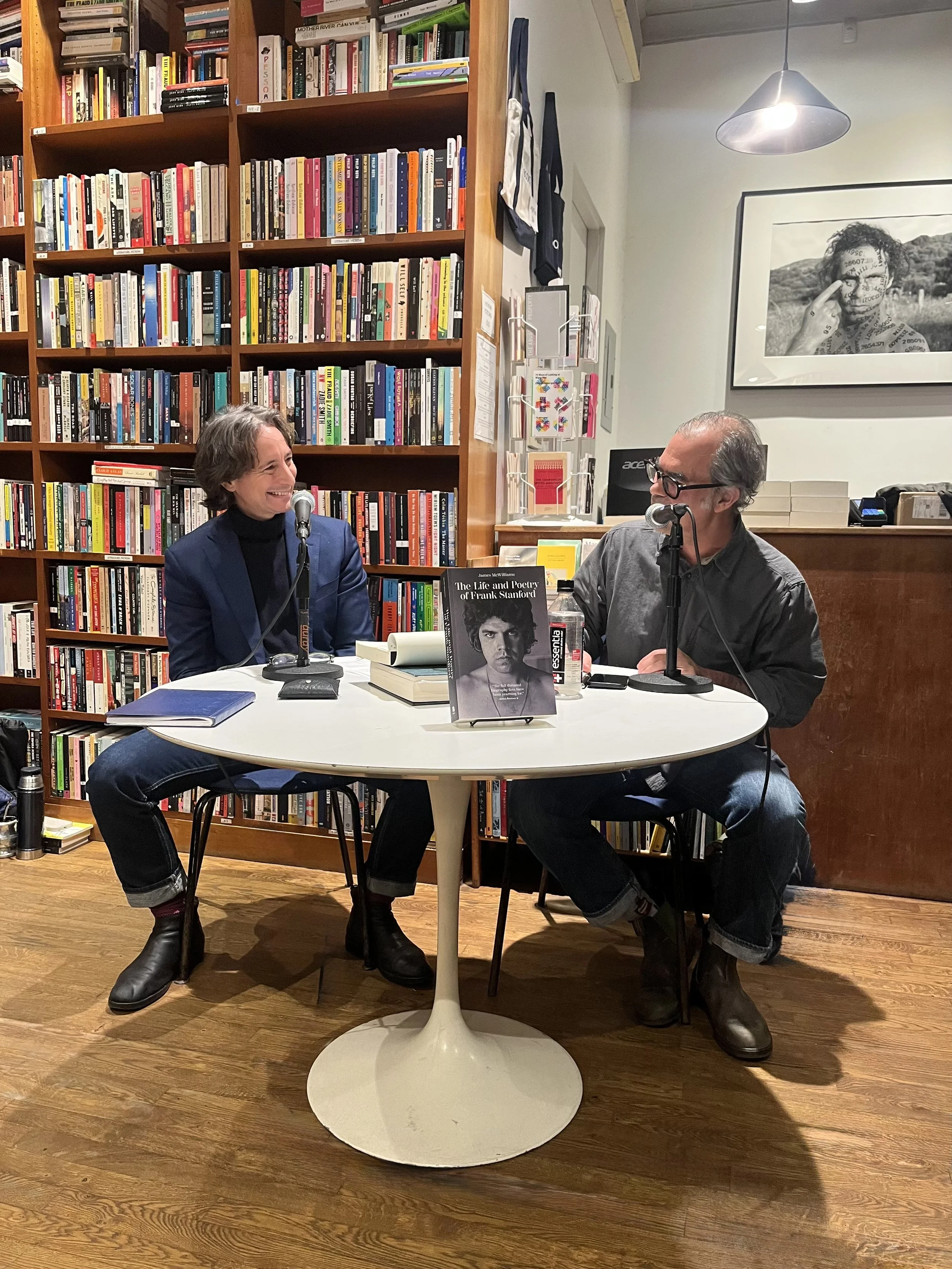
Patricio Ferrari (left) and James McWilliams (right) at 192 Books, New York City. Photo Credit: Lee Ann Brown
PATRICIO: I am thrilled, as a Frank Stanford lover, to finally have this book out in the world, with more to come. Reading this page-turner over the last week, I kept thinking about poets I love, and about what the poets we love make us feel when we first encounter them. I also kept returning to the fact that so many great poets died young. “Whom the gods love die young”: we find this aphorism in the Greek comedian Menander; we find it in Leopardi and in Pessoa, when he refers to his beloved friend Mário de Sá-Carneiro, who died by suicide in Paris at the age of twenty-five. And, of course, we can think of poets whom Frank Stanford himself loved and who died young—Keats and Byron come to mind. If poets throughout literary history have returned to this aphorism, perhaps it is because there is some truth to it: at least the truth that youth can generate myth, and there is a great deal of myth around Frank Stanford. We’re going to talk about that myth-making—what Frank himself created, what the people around him in Fayetteville created, and, of course, what followed after his suicide. But as I was thinking about all of this—the myth-making, the poets before Frank, and Frank himself—I was also struck, reading this deeply informed and scholarly book, by the effort and passion James has put into the project over seven years. That is moving to me as a poet, and also as a scholar. We have all read many biographies, and I think this one shows what nonfiction, and biography in particular, can be: a work in which a lover of Frank Stanford can find a reference for everything James writes, literally every claim—whether in the archive at Yale, in archives that are not yet public, or in conversations with people who are no longer alive but whom James was able to interview during the process. That is extraordinary, and something to celebrate. The work, the love, and the passion brought to the making—and unmaking—of the myth of Frank reveal a human being at work: driven, funny, reckless, and yet disciplined from a very young age. We feel that throughout these pages. So, for someone who left behind a body of work that still unsettles and moves us almost fifty years after his death, it is truly celebratory to finally have this biography, with more to come. Thank you, James, for being here with us. I turn the mic over to you.
JAMES: Thank you so much. I feel like we should just end right now. I feel so good after that introduction. It’s been such a successful evening, thank you so much. I really want to thank Terrence and 192 Books for hosting this event, and to Patricio for putting it together and for reading my book so carefully—it’s an enormous compliment.
So I want to begin just by saying a little bit about Frank Stanford’s death, and I’m going to read a passage from my introduction which gets into his life. Those of you who know about Frank Stanford, most likely know him through his death, or at least are quite aware of his death. He shot himself three times in the chest with a .22 revolver on June 3, 1978, in Fayetteville, Arkansas, after having an argument with his wife and his lover, who had recently discovered each other. It’s a dramatic death, and my way to handle it—it’s contributed to a lot of the Stanford mythologization—so the way I decided to deal with this posed a bit of a narrative problem. I just decided to get it out of the way in the beginning, and to write a preface where I not only get it out of the way, but de-romanticize it as much as I possibly can, and the way to do that was to track down every possible detail about the suicide itself, the weeks leading up to the suicide, and then just sort of put a period at the end of it and say, “Okay. Now we’re going to move on.” My hope was, as I wrote the book, that readers would read it almost forgetting how it would end—that it would engage readers enough to kind of pull them into the story as if they were going through it in real time. So for you to say that it’s a page turner, is very much a compliment and really makes me pleased with the strategy that I chose to get the suicide out of the way. I’ve actually started some readings just by reading that preface, and it’s really not the best way, mood-wise, to begin an evening focused on the joys of literature. So, what I’m going to do is read the introduction—not the whole introduction—I’m just going to read the first couple of pages, just to give you a sense of Frank’s life. This is going to cover some biographical information, but also the tone of the writing, as well. So again, after you finish the horrible story in the preface, I open up this way. [James reads introduction from The Life and Poetry of Frank Stanford].
PATRICIO: Tell us a little about how you knew—first as a reader, of course—and then how you knew you wanted to embark on what became a many-year journey. You certainly didn’t know it would mean seven years of reading, rereading, interviewing hundreds of people, going to multiple archives across the country, including Yale and Washington State, where Frank’s former editor, Irv Broughton—so loyal to Frank, and the publisher of seven of his books, I believe—preserved a significant part of his archive, and then following so many other trails. When did you know, and at what point did you say to yourself, “What have I gotten myself into?”
JAMES: Yeah, so when you just mentioned everything that I had to do to write the book, if I would have known, I honestly don’t know that I would have. Because when I proposed this book to my editor, I said, “Oh, you know, he only lived twenty-nine years, his archives are at Yale—give me three years and maybe two hundred and fifty pages.” And here we are, you know, six hundred pages and almost ten years later. So, I don’t know. What I had to do to write the book, did not become clear to me until I had already made the decision to write it. And, you know, there were points where I thought, “Oh, this is going to be too much. I’m not going to have the resources to do it.” Thankfully I didn’t listen to that too much and kept going with it.
But in terms of why I decided to write this book, the most honest answer I can give to you is I fell in love with Frank Stanford’s poetry and I felt like he didn’t have the exposure that he deserves. So in some ways this book just comes from a little bit of an angry sense that the underdogs don’t get their due, and I think Frank’s poetry was very much concerned with the marginalized and those who didn’t get their due. I felt like more people needed to know about Frank Stanford. I think during his lifetime the fact that he, as a poet, was deeply committed to the American South and the hills of northwest Arkansas, kept him from getting attention in places like New York. Now I should say he did subvert opportunities to get that attention, and maybe we can go into that later, but the motivation to write this book was to put my shoulder behind Stanford and his reputation and try very hard to push him at least towards some sort of canonization, at least some sort of anthologized presence with his work, which he doesn’t get. The other reason is that when I find people who have discovered Stanford, including you, there is something just different about the discovery of Stanford than the discovery of other forms of art. It seems to hit people in a particularly emotional and visceral way, and I just get a charge out of that. I have discovered writers that made me feel like, “Well, I’ve now won the lottery!,” and I want others to have that experience as well. So, that’s all part of it.
I could go into when I first started reading Stanford and all that, but that’s not terribly exciting. I’ll tell one quick story though, and that is I was in line reading “The Mind Reader,” which is a long poem of Stanford’s, and that was the first time I encountered the poem—I think it was 2016, and I was in line to rent a car in Boston and I fell into this poem—it’s a super long poem, and when it was my turn to go, I was just like, “No, no. Go. Go. Go,” [makes gesture waving others in line to go ahead of him]. So when that happens, you got to sit yourself down and say to yourself, “I gotta pay attention to that.”
PATRICIO: But your first encounter was with The Battlefield, right? The Battlefield Where the Moon Says I Love You is often considered Frank’s greatest work—the book he worked on for nearly half his life, at least ten years, if not more. When we strip away the legends surrounding its composition, what do we actually know about how the poem came together? And perhaps most importantly: what is so extraordinary about it? What did it do that had not existed before, and why has there been nothing quite like it since? What makes it so important to this day?
JAMES: So, The Battlefield is over fifteen thousand lines long, it’s unpunctuated, the first sentence is the last sentence, it’s hundreds and hundreds of pages, but it’s unique in a number of ways. One, Stanford delves deeply into the various registers of Southern vernacular, and as you read The Battlefield you’re going to hear—it’s set in 1960, the protagonist is a twelve-year-old boy based on Frank himself—and you’re going to hear upper-class registers coming out of the ballroom at the Peabody Hotel in Memphis—his family was well connected, they were wealthy, they went to the country club—Stanford knew that language, he was comfortable with that language. But as a kid, Stanford, because his father was a levee engineer, also went to levee camps in the middle-of-nowhere, Snow Lake, Arkansas. And when he was four, five, six, seven, eight-years-old, he and his sister were the only white kids there—all of his friends were black. Essentially unsupervised, he had these feral summers. His mother was working the commissary there and over-seeing the books of the operation. The father was over-seeing the levees. Stanford and his sister and these kids just kind of ran wild. And you get that register as well. So Stanford absorbed at a very young age the register of poor black country kids, and that worked its way into his poetics as well. The Battlefield is the only place in all of his poetry where he fully lets that go—where you get the contrast between the lower, rougher registers of the Mississippi Delta and the higher registers of the country clubs and the ballrooms.
PATRICIO: And even foreign languages.
JAMES: And foreign languages—Italian, Spanish, French, German, Japanese—and he knew none of those, by the way, but he somehow got them into the poem as well. So you get the U.S. South, you get various Souths, but you also get a kind of omnivorous global appetite that is worked into the poem as well. It’s very hard to describe the poem, but the way I would do it and the way I try to do it is imagine if Faulkner and the bluesman Robert Johnson and Jean Cocteau got together and put together a poem, it might look something like that.
PATRICIO: Do you want to read a few lines from it?
JAMES: Oh, I would love to. [James reads excerpt from The Battlefield Where the Moon Says I Love You]. I mean, it just gives you a sense of the language—reading that, kind of, don’t try it at home right away. One of the joys of this poem is it’s unpunctuated, but I actually think that it is punctuated, the punctuation is just not visible. So you have to add it, you have to put it in as you read, and it leads you to invest more into the poem than you might otherwise.
PATRICIO: Tell us a little more about the John Stuart Mill quote—“utterance overheard”— and about what might be called the “lower tones” in Frank’s work.
JAMES: Frank was led by his ear. He listened to the way that people talk, and he actually said at one point that when he listened to people talk, he waited—almost like a psychotherapist doing analysis on somebody and waiting for that Freudian slip, and when that happens they dive in—that’s what Stanford does. He would listen to people talk. As a college student, he particularly hung out at the only black owned business around, it was a bar in Fayetteville, Arkansas, called Sherman’s Tavern. And I actually tracked down people who were with him there, and remembered him there. And I asked them, “What was his demeanor like? What was Stanford doing there?” And he was waiting for utterances overheard; that is what he was doing. You said “John Stuart Mill” and my heart leapt. I’m like, “Did I include John Stuart Mill in my book?” But you’re right, I did—I added that towards the end. So Frank would wait until he heard something that really sounded interesting to him, a way of phrasing something, and then he would make note of that and put it into The Battlefield. There are some great scenes within The Battlefield where young Frances (who is modeled after Frank Stanford) is listening to his chauffeur, Charlie B., who he admires. He thinks Charlie B. is the coolest cat ever. And he listens to the way Charlie B. talks, and he actually says to him, “Can I talk that way?” And Charlie B. says, “You can try.” And this gets into some pretty complicated territory because this gets into, “Can I use the n-word? I hear you using it all the time.” And Charlie B. goes, “Mmmmm you can try.” And he kind of gets a little excited using it, so Charlie B. goes, “Ok, that’s enough. You’re done.” But there’s this experiment going on: how far can I go to use this dialogue? The other thing you can look for as you read the poem, is Frances at times will speak in perfect “proper” educated English, but over time his language becomes more and more vernacular—more and more like he wants it to be.
PATRICIO: For those who might ask today, “Isn’t that appropriation?”—when we read your second chapter, one of my favorites, and understand how Frank, from the ages of four, five, six, and seven, spent so many months at the levee camps over the summers, perhaps more than a year or a year and a half in total, hanging out with these kids—he was probably speaking that way, too. So when he later turns that vernacular into literature, he is doing it from the body as well. He is tapping into memory.
JAMES: Absolutely. So these early years, the imprint of that language was very deep. There’s no question about it. But he stopped going there at about the age of eight or nine, and then when he went to boarding school, he went as a stereotypical white racist Mississippi kid, you know. He hung a Confederate flag on his dorm room, he wore a Confederate cap, he talked about the old South, and actually treated the one black kid in his class horribly. And then he converted back when he met this group in Fayetteville. So, the appropriation question is difficult. It is appropriation on some level. It’s undoubtedly appropriation, but you’re absolutely right. There was a genuine grounding in this language, in this culture, as a young child. But I would say this: the appropriation, if that’s what we want to call it, was driven by genuine impassioned curiosity—he just liked the sound of that language better, and wanted to be around people who spoke that way. And this contrast became most intense when he was an undergraduate taking courses in the MFA program, and he’s in these seminars where people are speaking like MFA poetry students, and he’s like, “Fuck that!” Then he would go to Sherman’s and be like, “This is what I want to hear.” So, it was genuine.
PATRICIO: That question—what is wrong with the sound of American poetry?—that comes up, and it is connected to all of this.
JAMES: So he introduced these poems, bringing in these idioms and this country vernacular into the seminar, and people loved it. They found it to be an honest expression.
PATRICIO: Maybe you could tell an anecdote about how that happened. He was an undergraduate, and then suddenly he is sitting with the graduate students. How did that come about?
JAMES: Right, so he was an undergrad. He started as a frat boy and a business major, you know, to make his mother happy. Because this fit the role that she wanted him to play. He had not come out yet as being adopted, so he was still ingrained in the old Memphis expectation of living the way he was supposed to live based on the family that he came from. But he quickly broke away from that. He started to take some English classes and Philosophy classes, and I think he was deeply, deeply interested in those Philosophy classes, and you know, eventually declared himself an English major. And was writing poetry this whole time. I mean actively writing poetry—writing poetry for days and days at a time without sleeping.
PATRICIO: Beginning in high school?
JAMES: Well, he actually probably began writing as a pre-teen. Some of his poems are from the age of nine. So he really was a prodigy. It’s unclear to me actually how his poems landed in the hands of Jim Whitehead, who was a poet and novelist who ran the MFA program. Whitehead saw a few of his poems and was really blown away by them, and said, “I want this kid in my seminar.” Now, Frank showed up in the seminar, and Whitehead immediately loved him. Because Frank Stanford was about 5’9”, he was a really strong person—he did Judo, he was an athlete, he was muscular—and Whitehead was a big guy, football player from Vanderbilt, muscular—and Whitehead hated the fact that all his MFA poetry students were these scrawny, pasty, greasy-haired kids. He wanted some virile masculinity in the classroom. So he saw Stanford and said, “You will do sir,” and brought him in. Stanford’s poems really ended up impressing and winning over the entire seminar. And I should also add that this is a day and age when poetry was delivered in these seminars, there wasn’t this sense of, “Oh, we must not hurt their feelings. We don’t want to ruin their inspiration, or damage their self-esteem.” Like people actually aimed to send you home in tears. And some people did go home in tears. So, Frank endured a pretty rigorous gauntlet in that seminar.
PATRICIO: Were there other important moments for Frank during that program—moments he benefited from in a positive way? Great encounters that happened because of this poet or that poet, this editor or that editor?
JAMES: So Frank, he did not—I don’t know. He was never very generous about the other students around him. And I think this was part of the myth-making Frank. He wanted to be the lone genius. He wanted to be the prodigy. He wanted to be the youngest and the smartest. He even did things, like when he edited a journal in 1971, he changed the ages of some of the people publishing that journal, so he would be the youngest. And this mattered to him. So, he didn’t want to claim any kind of affiliation or collaboration or influence by some of his peers. But when Allen Ginsberg came, oh he could pull it together and really impress Ginsberg, and when Alan Dugan came. So these poets who came—Frank was not obsequious, like he wasn’t disingenuous in terms of kissing up to them, as it were—but he put on a good act. He acted like the kind of person who you would want to hear more from. And he wasn’t that way with his peers, but he was that way with these impressive poets who came. And his career really did benefit immensely from Alan Dugan’s support.
PATRICIO: And then, at some point, after two semesters, he’s no longer an undergrad, but he doesn’t want to sit in the MFA workshop anymore. Then he goes to this conference, and Irv happens. We learn through your book that we would not have Frank Stanford—at least not the Frank Stanford we know today—without Irv Broughton.
JAMES: Oh, it’s the pivotal moment. So Frank went to this conference, it was the Hollins Writers Conference in 1970. And while he was there, he met Irv Broughton in the parking lot. They chatted, and Irv had a publishing company that consisted of Irv. It was funded by cash advances on his gas card. But Irv read the twenty-two poems that became The Singing Knives, because Frank had his manuscript with him—he was planning to shop it around. They had breakfast the next morning and Irv said, “I’m in love with this. I want to publish it.” Now around the same time, Stanford was also approached by a friend and another editor who was gonna show it to Random House, and said that she was pretty certain she could get Random House interested in The Singing Knives. So, you gotta think about this for a second. Here’s Frank Stanford, he’s got Irv Broughton and Mill Mountain Press with no budget, and he’s got Random House. And Frank went with Irv Broughton. And I think it’s pivotal, not only that he met Irv, but that he made this choice. Because in doing so he determined that, “I am going to maintain compete control over my poems. I don’t want anyone editing my poems,” and that would remain true for most of his life—there’s a couple of exceptions to that. [….] Also he was declaring that, “I don’t trust the big, commercial venues. I just don’t think my art will thrive by going into those commercial venues.” And this sounds romantic, it also sounds naive, and I think it’s both. But I think what Frank got out of this decision was Irv Broughton publishing his chapbooks, and these chapbooks sort of infiltrating their way into Fayetteville, and people guarding them and protecting them as if they were the most valuable possessions that they had ever had. And they still have that caché. If you want to go online today and buy Arkansas Bench Stone: four grand. So it’s impossible to overestimate how deeply Frank loved the cult appeal that he had, and how deeply committed he was to remaining off the commercial grid. He valued that very deeply. Now, of course, that’s why a lot of people who even read a lot of poetry haven’t read Frank Stanford. There was a cost to that. But that’s the choice that he made in that parking lot in Hollins that summer.
PATRICIO: Is there anything you want to share that you learned—not only through reading and rereading his published work, but through the archives—about his creative process? And perhaps also about the different versions he made after Bertolucci, Pasolini, and other artists, writers, and filmmakers?
JAMES: So, the first thing to say about Frank’s creative process is that he was prolific. I mean, manically prolific. One of the cardinal rules he had as a poet was, sort of: if you were ever aware of the fact that you’re writing poetry, then you’re not writing very good poetry. It was very important to him to enter a kind of altered state. Not with psychedelic drugs, or anything like that. He used sleep deprivation and alcohol—a slow drip of bourbon, or beer, to enter a place where he felt detached enough from reality, but connected enough to his senses that he could turn out the poetry that he wanted to turn out, and then he churned it out. And so, “The Battlefield” was actually one poem of fifty others of a larger manuscript called “St. Francis and the Wolf” that may have at one point exceeded forty thousand lines. At one point, he had a mental break and burned some of his work. It was fifteen thousand pages of work. [….] But the other thing that was fueling him, was not just his ear for the way that people around him were talking—that kind of search for a Freudian slip as it were, or ‘utterances overheard’—by the mid ’70s (’73-’74) he started to think that he wanted to bring global voices into the South to see what would happen. And so, he started to read into the French Surrealists, the anti-poems of Nicanor Parra, Japanese warrior poetry, and what he would do—and you can probably explain this a lot better than I could, so I’m actually going to bounce this question back to you. [….] He would take a poem, say for example by Jean Follain, and with a dictionary he would translate it word for word, or have somebody who knew some French to translate it for him, and then he would rewrite it.
PATRICIO: I’ve never seen anything quite like this—and I don’t have a name for this—because it is not necessarily a “version,” since the poems remain so close. Yet in four or five lines, say, in a ten- or twelve-line poem, he will do something—and you quote Borges in the book on the “color local”—where Frank changes an image that Follain uses, a distinctly image of a place, and turns it into something that feels like Fayetteville: a soda case, a corner store.
JAMES: At one point he has the character in the poem—I think in Follain he’s sitting on some steps—but in Stanford’s version, it’s an old porch. And at one point the protagonist of the poem in the Stanford version spits. Nobody spits in the Follain version.
PATRICIO: But if you read the opening of the poem, or the end of the poem, the words are almost word for word. So you would say this is almost a literal translation—but then, when you read those four or five lines, it becomes a transcreation, though not exactly that either. It’s something I’ve never seen before, and he’s does it in many poems. It’s so interesting to look at, because no one was doing this at the time in Frank’s radar, and Frank—out of intuition and need of those global voices—began doing it.
JAMES: I think it’s worth remembering that he did this because he was always looking for a deviation from what was familiar to him. So I think by ’74-’75, he had kind of worked his way through the country vernacular, and he was even getting some feedback from people he trusted like, “I think you’ve done this enough. I think you’ve done all you need to do with that language.” And it’s then that he started to look abroad. But notice that he didn’t go abroad—he brought those poets and those filmmakers to Arkansas, and he put them in that environment almost just to see what would happen. And I would think that was something that really excited him. He didn’t know what was going to happen.
PATRICIO: Even today, it’s so interesting to read this work and to see how exciting and creative such a process could be for any of us as writers. Since we are in New York, maybe you could tell us about what was, perhaps, the most foreign place Frank ever went: New York City, for a month in 1972.
JAMES: Yeah, so Frank spent his whole life in the South with the exception of five weeks, and three and a half of those weeks were here in New York City. He stayed in Staten Island. He took the ferry across every day. He wrote on the ferry. He loved the ferry. But when his feet hit Manhattan, he went to movie theaters—he saw a hundred movies in three and a half weeks. He had a real appetite for foreign film, and he had a hard time getting those films where he lived in Arkansas. Although he tried—he tried to open a theater and got Janus to send him a bunch of films, but his appetite exceeded what was possible in Arkansas. So he usually went into the theater sneaking in a bottle of wine or two, he would drink and watch movies all day, and then towards the end—oh, for those three weeks he somehow had six girlfriends, and one of them worked at the MoMA and she would let him in at the end, so he could wander around and look at the art. So it was a culturally immersive experience for him, but he didn’t like New York. He said, “It’s a strange place.” He never really felt comfortable here. And the woman that he was staying with on Staten Island was a girlfriend—he left without telling her, snuck off with the woman from the Met, she rented a Mercedes, they drove to D.C. to meet a friend of hers, she went in to see the friend, Frank bailed from the Mercedes and found a bus to Mississippi.
PATRICIO: A letter from this lady, Cheryl, saves his life in a way, right?
JAMES: Yeah, so the woman he stayed with, Cheryl, was in many ways, I think, the woman that Frank loved—to the extent that he truly loved a woman—I think he loved Cheryl more than any of the women that he was with at the time. So I couldn’t find her, until almost a year and a half before I was done with the book. I found her, and she had thirty-five letters from Frank. She had stories to tell. So I had to kind of take her story and weave it through the book, because I didn’t find her until then—she had a different name at the time. I was looking for Cheryl Campbell, turns out her name was different, and how that all happened is a story in and of itself, but it involves—y’all remember watching Sesame Street and they had that black modern dancer on there who would often come on as a guest? He was actually my connection. He lives in Jamaica, and he had owned the house that Cheryl was living in, and I ended up finding Cheryl that way. When I got her last name, I was on the phone with her within twenty minutes and she said, “I will tell you everything.”
PATRICIO: She’s an extremely important figure in the book, and in Frank’s life.
JAMES: Oh, tears came down my face. I had to call my editor and tell him I’m not going to have the book done—it’s going to be even later.
PATRICIO: There is a mental-hospital moment for Stanford—he is there for a week, or ten days—and then a letter comes.
JAMES: Oh, I didn’t even answer your question. So, he tries to kill himself in 1972 by swimming until he passed out. He went and got into Lake Dardanelle, which is a lake near Subiaco, and he swam for, I think, over eight and a half hours. But he made it back to shore, and one of the monks came running up and said, “You have a letter! You have a letter!” And it was from Cheryl saying, “I’ll take you back.” And he wrote to her about how she saved his life.
PATRICIO: Could you say something about the years 1974 and 1975, a very stable and productive period for Frank? He is living in the country with his second wife, Jenny, and that is the time of Field Talk and other chapbooks.
JAMES: Yeah, he met, Ginny, his second wife, Ginny Crouch Stanford—who is today quite a prominent portrait painter. She painted Hillary Clinton’s White House portrait, I believe. But at the time she was just learning to paint, and they really bonded. Like Frank had visions that he wanted her to paint, and he would write poems based on those paintings. It was a really kind of a beautiful symbiotic relationship, artistically, that they developed. They chose not to live in Fayetteville. They moved to a very rural area on the edge of Rogers, Arkansas. They lived in a modest house with a nice view of Beaver Lake. Frank was working as a surveyor and writing poems. Ginny was painting all day. They had a garden. Frank quit drinking. He was keeping a really responsible budget. It was remarkably stable, and Frank couldn’t stand it. It only lasted about two and a half years, and he started to kind of—whatever kind of wildness he needed to indulge—he started to dip his toes back in by going back to Fayetteville, sometimes into Eureka Springs, to hang out in bars and hear that language again, and he got sucked back in to a point—that’s when he met C.D.
PATRICIO: Before we move there, maybe we can read one poem. May I ask you to read?
JAMES: You don’t want to read it?
PATRICIO: No, I would love for you to read it.
JAMES: Which one?
PATRICIO: “Plowboy,”perhaps.
JAMES: Why don’t you read it?
PATRICIO: No, please. Please, James. This is how Field Talk opens [addressing the audience].
JAMES: So Field Talk, as Patricio mentioned, was most likely written around this time of relative comfort. There’s a lot of gardening, did you notice that?
PATRICIO: Mhmm. Mhmm.
JAMES: [reads “Plowboy”]. That’s a beautiful poem.
PATRICIO: Thank you. So, moving towards the end—so he meets C.D. Wright in Fayetteville around ’76?
JAMES: It was October of ’75.
PATRICIO: So right around the time Field Talk comes out.
JAMES: It was right around that time. Frank’s reputation in Fayetteville was huge at this time. You know, he published all these books—to see Frank in the streets of Fayetteville was worth telling about, it was a story you would tell later. He went back to a party that Jim Whitehead was having, and he went because, I think, there was going to be a screening of the film that he made. We didn’t talk about that, but he made a film in ’74, came out in ’75, that won an award at a film festival in Seattle.
PATRICIO: And it’s a film that’s available, right?
JAMES: You can watch it on YouTube. It’s called “It Wasn’t a Dream: It Was a Flood.” And so, his stock was high. He went into Fayetteville. He went to this party, and I think he intended to catch up with people, but he ran into C.D. Wright and they went into Jim Whitehead’s office, and they talked for four hours. And then he gave her his, like onion-skin paper, typed copy of The Battlefield. She read it through and was completely in awe, and in love, with Frank. And they used the starting of the press, in some ways, to move in together—that was the cover because Frank was still married to Ginny. Ginny was feeling his absence more and more. Ginny ended up moving to southern Missouri where her family—she inherited a pretty grand home from her family. And those were the years where he just lived that big lie—two and a half of them—and went back and forth between Fayetteville and southern Missouri.
PATRICIO: Even so, could you say something about the collaborative role he played in nurturing the women he was with, artists like C.D., Ginny, and others as well?
JAMES: I really do doubt whether Frank Stanford was capable of having—I hate to use terms like normal or healthy—but a kind of loving, committed relationship. He interacted with Ginny and C.D. through art. That was really the main way he communicated with them. And so, with Ginny, as I mentioned, he would instruct her, you know, tell her in many ways, what to paint. And she loved his poetry, she trusted his aesthetic vision and did it, and benefitted from it by her own account. C.D. as well, she allowed Frank to take her under his wing (in terms of poetry), and I think Frank taught her a lot. One of the biggest challenges that C.D. faced as a young poet was, of course, coming out from under that wing. And by her own admission, said after Frank’s death, “My poems are sounding very much like Frank Stanford, and I’m trying very hard to get out from that.” And she does, of course, eventually she does. For as terribly as Frank treated many of the women that he was with, when it came to their art, he put their interests first. And I really mean that. In some very concrete ways, he put their growth as artists ahead of his own. He was extremely supportive of them creatively, artistically, and professionally as well.
PATRICIO: Is there anything you want to say—I don’t know how much time we have—but I would love for you to say something, of course, about “The Saint of New Orleans.” You dedicate the book to Ralph Adamo, whom I had the pleasure of meeting in the summer of 2017, when I traveled around the country with my mother. It was wonderful to meet Ralph, a poet and a friend of Frank’s. What did you learn with him, and through him?
JAMES: Okay. So Ralph, in some ways, is the epitome of my entire experience writing this book, which was interviewing Frank’s friends, acquaintances, colleagues, and family, and then branching out to interview people who maybe didn’t know Frank directly, but knew of him. Bottom line is, I don’t know, this sounds so corny, but people were really generous and wonderful. Like I kind of reached the conclusion that when it comes to actually what matters, which is promoting the great work of a poet who hasn’t had his due, people gave me so much. And Ralph was at the top of that list. The first formal interview I did for this book—and I should say, I didn’t know how to do interviews. I went into this blind and cold. I went to New Orleans, I met Ralph, I scheduled about an hour, and we talked for four and a half hours. And we were just getting started, and he made it clear to me that he would always be there for me in any way. So, he was a constant throughout this book. I went back to Ralph hundreds of times, and he was incredibly generous. He’s also one of the very few people who would ask me like, “Are you losing your mind?” and “How are you feeling about it?” He would check in with me emotionally, as well. He’s incredibly humble, and he’s an amazing poet who, I also think, has been underserved in many ways, as well.
PATRICIO: He was part of the MFA program, right?
JAMES: Oh yes, he knew Frank very well. They were part of the program together, and they stayed in touch, until Frank’s death.
PATRICIO: And Frank spends his last night with him before flying back to Fayetteville.
JAMES: yes, with him, but then later with Kay DuVernet, his lover, a photographer whom he cared for deeply.
PATRICIO: Before we turn to the audience, I would like to ask two things. First, could you say something about the archives? We know what we know from what Frank published in his lifetime, and of course from this book and what has appeared posthumously—but what is in the Beinecke? And also, what is beyond the Beinecke? Because the Beinecke is not the whole archive.
JAMES: No, not by any stretch. I want to say that the Beinecke was an absolutely great place to work. They were so supportive during COVID about getting me scans of documents. I can’t compliment that library enough, in terms of how they supported me. But they don’t have anything close to a full collection of Frank’s archives. And I should say that when I started this book, I thought it was. You know, I had to go and kind of build the archive drawing on the Beinecke, I organized Irv Broughton’s archive—mostly letters between Irv and Frank, but other things as well, including drafts of early poems, markups of early versions of The Singing Knives or Field Talk or some of the other poems, some of Frank’s art, Irv did interviews with Frank, as well—a ton of stuff. As much, if not more, than the Beinecke. Then Frank’s niece, his sister’s daughter, also had boxes and boxes of completely unprocessed Stanford stuff. I went through it, I built the archive—there’s an archive of photographs, there’s an archive of newspaper clippings, there’s an archive that includes his baby book and his fishing records from when he was ten to twelve years old. And so, that took an enormous amount of time—organizing it, then processing it. What worries me is that for future Stanford studies, this stuff is really scattered. There are also letters out there that we haven’t been able to get ahold of. I went through Tom Lux’s wife’s attic, through every piece of paper Tom Lux owned, looking for those letters from Frank—not there. The wife of an editor (who has since died) in Maine, who has a folder of Frank’s letters that she can’t find. I had a friend go to her house and go through everything.
PATRICIO: There is a forthcoming volume of letters, correct?
JAMES: There is. So, there is a Selected Letters—not by me—A.P. Walton is putting that out, but there is still more out there. So, the bottom line is Stanford lived his life having no clue that he would ever be “Frank Stanford,” if you know what I mean. He didn’t know that there would be this kind of interest in his work. So when he wrote his letters, he was writing honest letters. He wasn’t writing letters that he thought people would read someday. As a result, people who got his letters weren’t like, “Oh, I got to preserve this Frank Stanford letter.” So, that makes it complicated as a researcher. There’s definitely still more to discover, but I think I got to everything I could without totally losing my mind.
PATRICIO: Before we turn to the audience, is there anything you would like to say—anyone you want to thank, or anything that comes to mind?
JAMES: Oh man. I mean, I guess, I think this is my last of all the book events that I’ve done. The last one for the season, I guess. I’ve got a few things in the spring, but you know, there’s no way I can really express my thanks honestly without sounding—I’m just so grateful for the way that people helped me do this book, so many people. But I will say, I’ve discovered by doing this that there is a kind of rare pleasure in getting together with other people who read Stanford, or maybe just want to read Stanford, and discussing those poems, and discussing that life. It’s something I never really expected to discover this late in life—I mean, I hope it’s not that late in life—but you know, the age that I am at. And it’s reassuring that you can make these kinds of discoveries as you move into middle age, and beyond. So, it’s been a truly, personally life affirming project that basically comes down to reading and discussing Stanford’s poems with other people.
PATRICIO: Grazie. Thank you, James. Thank you so much.

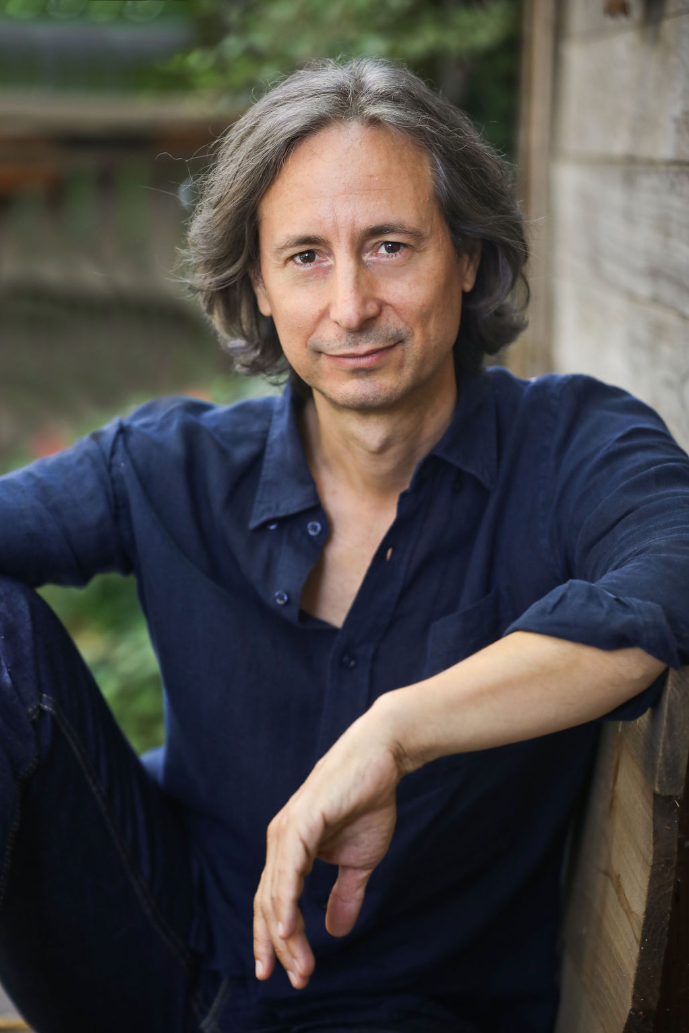
Photo Credit: Melanie Willet
James McWilliams is a writer and historian who teaches at Texas State University. He is the author of The Life and Poetry of Frank Stanford (University of Arkansas Press, 2025) and co-editor, with A.P. Walton, of The Battlefield Where the Moon Says I love you (University of Arkansas Press, 2026) by Frank Stanford. His work has appeared in Oxford American, Virginia Quarterly Review, The New York Times Book Review, The American Scholar, and Mississippi Review.
Patricio Ferrari is a polyglot poet, literary translator, and editor who teaches at Sarah Lawrence College. As translator and editor, he has published more than twenty books, including the complete works of Fernando Pessoa’s three heteronyms—Alberto Caeiro, Álvaro de Campos, and Ricardo Reis—co-trans. with Margaret Jull Costa, and The Galloping Hour: French Poems by Alejandra Pizarnik, co-trans. with Forrest Gander (all from New Directions). In 2026, Ferrari received the Fence Modern Poets Series Prize for Mud Songs, the first volume of his Elsehere trilogy.