
Book of Hours
Ellen O’Connell Whittet
Reviewed by Hana Wisnuardi
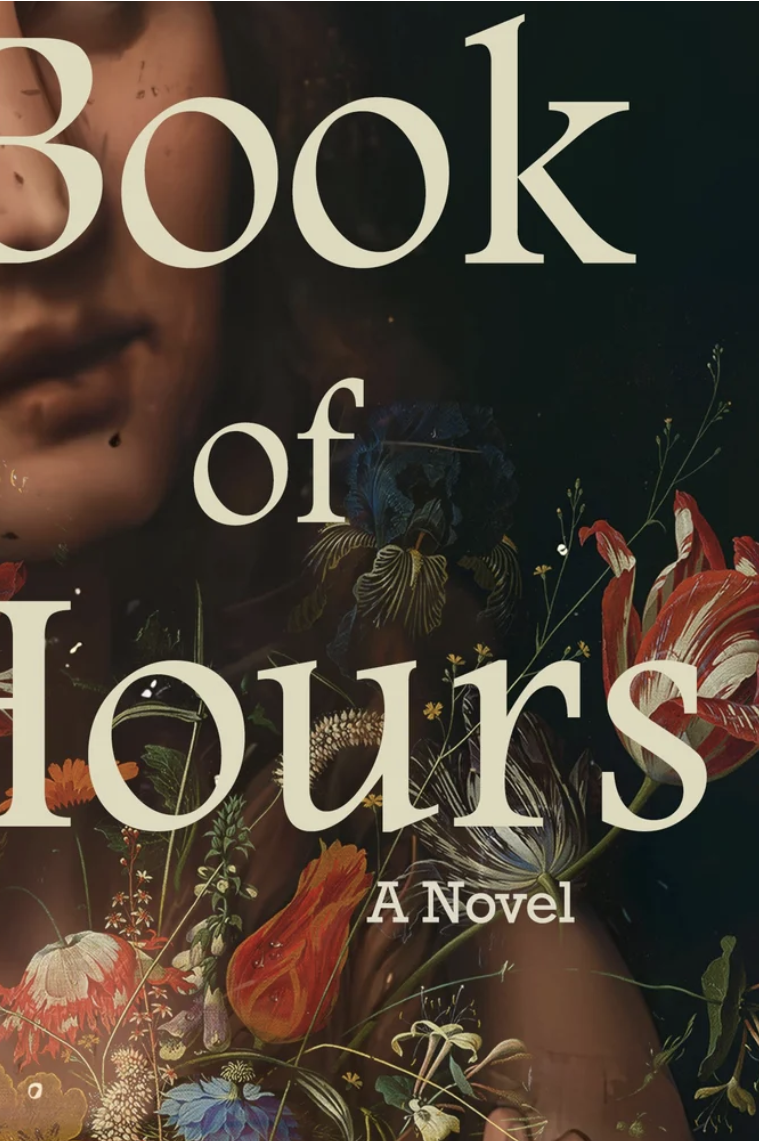
How do we make sense of power in the world and in our lives? Is there a reason we recognize certain powers while other powers elude us? What powers do we concede to, and what powers do we govern? In Book of Hours, Ellen O’Connell Whittet weaves and tunes threads between gender and violence, purpose and distress, power and love, and faith and autonomy. She presents these threads as both an instrument and a sticky web. Which threads can we play in an act of celebration, and which threads can we cut in a move toward freedom?
As with the Christian books of hours, Book of Hours offers a series of prayers and devotions expressed by the protagonist, “the woman,” as she grows up in a Catholic high school, sacrifices her PhD pursuit to marry her husband, undergoes IVF, and eventually gives birth to her child. Through these prayers and devotions, the woman searches for absolution, purpose, and faith, not only faith in a higher power, but faith in the structural powers she finds herself at the mercy of, and faith in herself.
Whittet lays a meticulous lace of Catholic iconography and history, especially of saints, atop each scene. These images of starvation, sacrifice, mutilation, and myth (for example, Saint Michael embodying a crown-shaped “curtain of water” that protected a pilgrim who gave birth in the sea) are transposed over the woman’s landscape, which infuses the otherwise contemporary setting of the novel with a rustic mysticism and a sense of timeless urgency. Under a veil of this mysticism and urgency, the way we view identity both takes shape and becomes transformational.
So much of the book is spent wading through discomfort or chipping away at the woman’s sense of innate purpose, but there are many moments of curiosity, discovery, and indulgence that make the novel feel lived-in and satiating. Whittet spends a paragraph describing rich pasta sauces, ricotta “plopped on a bed of roasted figs and tomatoes,” and homemade salad dressings made from sheep milk yogurt that the woman eats after she becomes pregnant. While reminiscing on her studies of French medieval women during the year she spent in Bordeaux, the woman describes having felt a “rich harmony” every time her professor translated from Latin to French, a harmony which “blurred the edges of a split she had felt since her Catholic high school days, between the communion of saints and forgiveness of sins, and the promises of the rest of the world.” These details not only add flavor and body to the novel, they also return a sense of power to the woman, likewise revealing to us which details we might be forgetting to acknowledge as empowering in our own lives.
The novel’s pulse can best be described as contractions—a constant tightening and loosening between violence and purpose. In the moments of loosening, the woman feels she is complicit in her own self-erasure. In the moments of tightening, the ordinary and the painful become worthy of reverence, and the language tips into the surreal. While vocalizing as a strategy to increase dilation during her labor, the woman lists things she tries to sound like: “a stag at first frost, a tree frog during mating season, a cat with its tail caught under a flower pot.” Despite the dizzying nature of these contractions, there is a solace in knowing that we never lose sight of the woman. Whittet ensures that she maintains a fullness of character and an authority over her story that assures us that true self erasure is impossible.
Discerning and elegant, Book of Hours dissects the question: what does it take “for a woman to be holy?” What Whitett comes up with is not an answer but a stunningly raw exposure of one woman’s—an everywoman’s—body and soul, and an exploration of the “violence and brutality [the woman] understood to be inherent to being a girl.” Some paragraphs inflict brilliant wounds, but Whittet generously supplies paragraphs that offer a salve for those wounds, too. The salve: even when life seems illusory or feels sore to the touch, even when we must contend with power, we are always wholly real and unmistakably complete.