
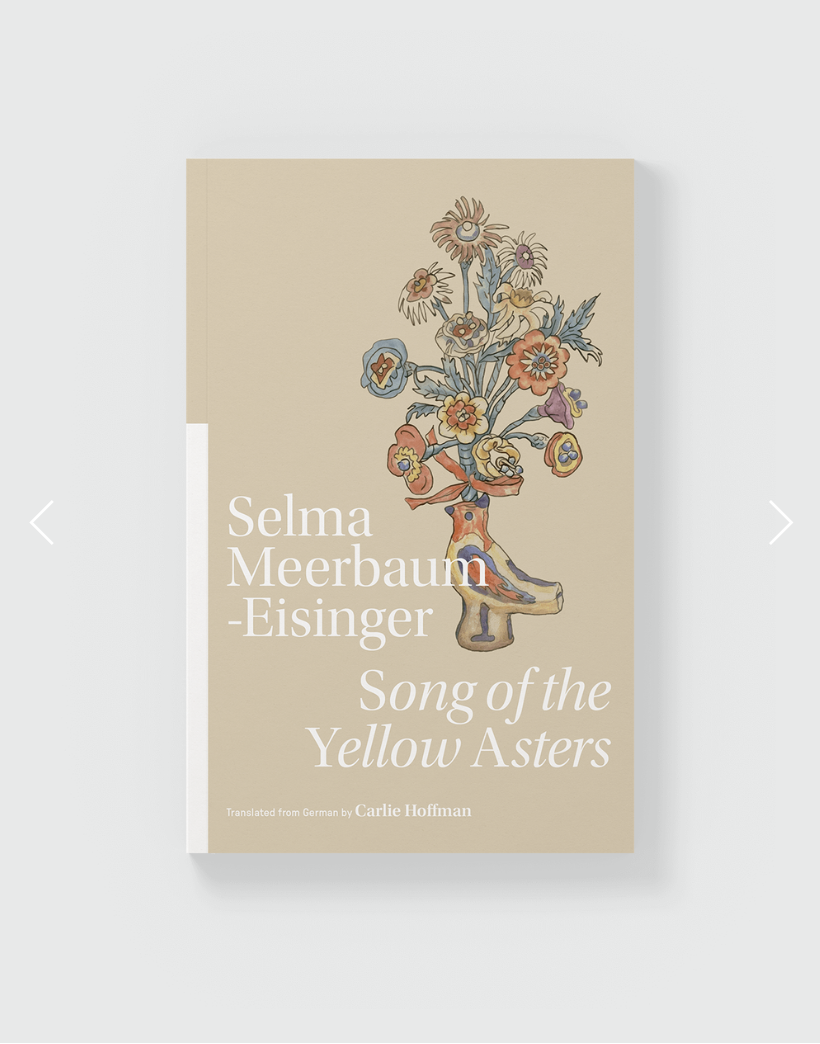
Song of the Yellow Asters
Selma-Meerbaum Eisinger
translated by Carlie Hoffman
Reviewed by D Kopec
As a translator, I think often of the sometimes delicious, sometimes extraneous tensions that can arise between a translator and the text they are translating. There are occasions where gold is struck; a harmonious union of a word and a translator’s articulation of that word. Times like these evoke a kind of “break” in the intermittently arduous flow of bringing literature from one language to another. Idioms, particular references, historical contexts, esoteric images: potential tension points, all. Tension and friction aren’t things to shy away from though, right? Struggles, minor and major, can represent transition points, wherein, profound and meaningful artwork can be made. Wonderful moments in translation can occur when there is a contrasting discord between a translator and a source text, whether it be background, style, context, or voice; this is true for moments of unison too.
Song of the Yellow Asters, by Selma Meerbaum-Eisinger, translated from the German by Carlie Hoffman, is an example of two poetic voices in melodious unison. A German-speaking Romanian poet from Czernowitz, Meerbaum-Eisinger began writing poetry in her early teen years. Paul Celan, the legendary Romanian poet, was her older cousin. Spare, impressionistic, nature-rich lyrics populate Meerbaum-Eisinger’s poems. They are Fabergé eggs of tightly charged dedication and grief, where, “A glass of water shimmers, dreamlike” and “The red carnation flares--/the room’s queen”
Meerbaum-Eisinger's lifetime was tinged with tragedies; she lost her father when she was very young, and the second World War broke out when she entered the 10th grade. Her family was deported to a forced-labor camp in Transnistria in 1942 and her life was claimed shortly afterward by typhus. She was 18 when she died. She wrote her poems longhand, in her journal and marked their end with the day’s date. She dedicated many of her pieces to her love, Lejser Fichman. Her hope was that her manuscript would escape Nazi-controlled Europe in Fichman’s hands as he fled, but he died en-route to Palestine. It took longstanding care, gritty tenacity, and dogged detective-work from her family and loved ones to ensure her poetry survived into the modern day.
Meerbaum-Eisinger’s German is clear and musical, often rhyming. It is melancholy and wistful, yet flowers bloom throughout the text. Carnations, roses, and of course, asters all star as subjects or supporting actors. Hoffman’s translation is equally resonant; she captures Meerbaum-Eisinger’s tuneful repetitions and sorrowful natural images with poise, while still maintaining a sense of when to punctuate with a thud. From “Song of Joy”:
One day, the magpie will be heard
and the sun will suddenly light up
and the snow will vanish, sheet by sheet
and the river will tremble one last time,
break the heavy, white blanket of ice—
send its flood,
see with delight the rose hedge, through bare,
foam and roar and laugh at the hunks of ice.
Meerbaum-Eisinger was also a deft and varied translator, although few of her translations survived the Holocaust’s erosion. She translated H. Lejwik from the Yiddish, Discipol Mihnea from the Romanian, and Paul Verlaine from the French. Before the war, Czernowitz was a rich, polyglottal arts community; growing up there must have been a boon for Meerbaum-Eisinger, someone fascinated with music and literature from a young age. Hoffman shows her prowess with lyric and language throughout the book, but I think it's undeniable when confronting her rendering of these translations of translations. To capture Meerbaum-Eisinger's reading of Verlaine, for example, in her own reading of the German that results, and to then, bring that to English in a voice that feels faithful to both, is staggering.
Despite the theft of Selma Meerbaum-Eisinger's bright, brief life, despite the world as she knew it crumbling around her, a persistent youthful hope resides in these lines. Meerbaum-Eisinger’s world isn’t stagnant in the face of fascist atrocity, rather, it moves like songs, rivers, and swaying stems do. They are petals on the wind, floating forth to catch your eye and delight. Hoffman’s gentle translations thrive in a springtime of yearning in the face of devastation, echoing out from history’s harsh defacement. From the poem, “Yes”:
You are so far.
As far as a star I want to hold.
And yet you are near—
just a little dusty
like the past.
Yes.