
Triage
Claudia Rankine
Reviewed by Ebonee Rice
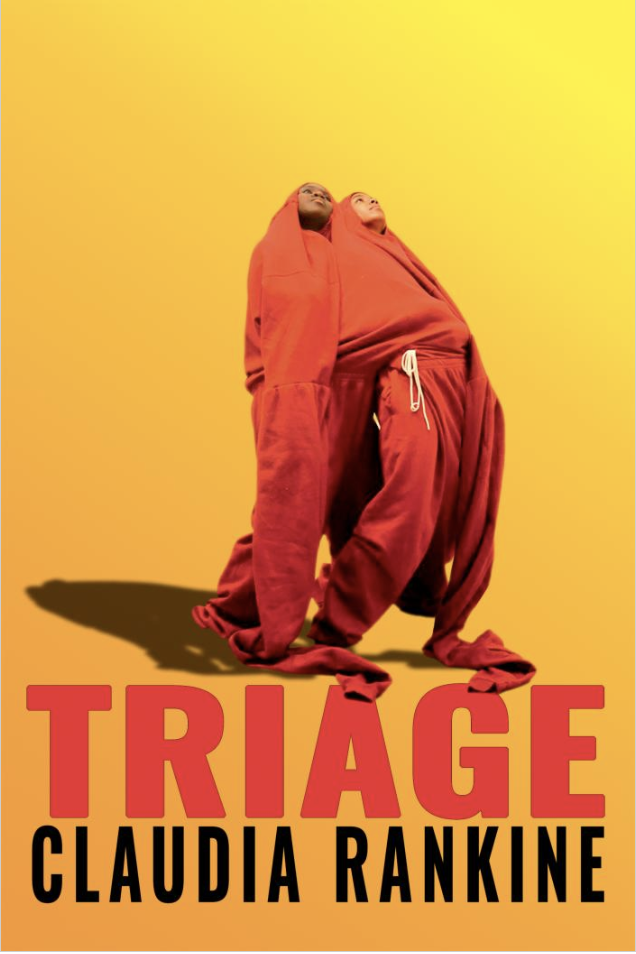
In her new book, Triage, Claudia Rankine continues her tireless work of pushing the boundaries of genre to reveal our culture’s most critical questions. Triage evades classification, weaving together poetry, prose, criticism, and narration to piece together a series of awakenings, both personal and political.
The book begins against the backdrop of Rankine’s formative undergraduate years at Williams College during the 1980s, a decade defined by the political friction of the Reagan era and the urgency of campus anti-apartheid divestment movements.The book follows Rankine’s life-long friendship with another student who we know only as “the theorist.” The theorist’s identity is an abstraction, becoming a stand in for friendship and an opposing political voice to Rankine’s own. As the two encounter the turbulent world around them, their viewpoints sharply diverge on the matter of resistance. The theorist is direct, almost aggressive in their call to action. Rankine’s viewpoint is more academic, cerebral, focused on holding space for the grief of the everyday. What unites the two is not necessarily a shared viewpoint but rather a bodily practice: together, the narrator and the theorist collapse as a sign of resistance. What this means, is that the two would be spotted on campus falling over together, oftentimes into each other’s arms. The narrator laments: “Looking back, I think our falling was a refusal of continuance, refusal of the illusion of flow, a recognition of injury, ours, everyone’s, as we travelled through time.” Triage is a decades-long conversation between the two; often it reads a love letter that spans across time.
Rankine pairs collapse with the metaphor of the couch; the couch is what catches us when we fall. She transforms the couch from an everyday object into an instrument of reprieve from the exhaustion of the present world. Placed between sections of the book are unusual, uncanny photographs of couches. Some are pristine and beatific, others are decrepit, caving inwards, slouching and abused, or cleaved in two with a thick seam of concrete. But, one must “get-up” from the metaphysical couch and move towards a larger purpose. Triage asks the question of how.
In this question, lies the core of the theorist and Rankine’s relationship. As the decades unravel, we get a sense of the distance between the narrator and the theorist; their communication fractures. The theorist spends time abroad, traveling all through Europe, sending fleeting postcards to the narrator. There are no phone calls. Despite their closeness in college in the years after, the narrator doesn’t have the theorist’s phone number. Eventually, a letter arrives from the theorist. Rankine rereads and rereads. She does not write back. It is only when the pair reconnect in 2022 that we get a sense of how much time has passed. The two are now in their sixties, removed from the sharp urgency of youth. After arranging a reunion at the Whitney Museum, the narrator and the theorist enter a conversation about the state of the world. It is then revealed just how close the two are. The narrator thinks to themselves: “Why do you keep looking at me?/I am lost in you./ Why do you keep looking at me?/ I am lost without you.”
In the final pages of the book, the two leave the museum to talk at the narrator’s house. We get a sense that it is one of their last meetings. Their conversation unravels as the distance between their worldview begins to feel like a chasm. The theorist calls for urgent resistance, condemning the narrator for quietly accepting the American government's meager standard for what it means to be alive. The narrator feels trapped in the inability to do anything against the onslaught of the state, claiming that “Every move feels like one of triage.” Their viewpoints accumulate: “‘But you can’t be suggesting we do nothing? The theorist raised an eyebrow.’’’The narrator answers, “‘What should be done? Burn it all down? Tell me.’”
In those lines we sense the tension that lies between the two; it bites. The culminating conversation between the narrator and the theorist is visceral, stunning in its attention to detail and fastidious in its appraisal of our current cultural situation. Their dialogue alone is reason to read the book. It reflects the diverging world views that capture the reality of being alive in today’s day and age. Do we continue the fight or do we lay down from exhaustion?
Claudia Rankine has produced a book that seems to capture our exact cultural affect. In her capturing of the theorist and her conversations, Rankine depicts each side as deeply human and deeply exhausted. At the end of the book, the narrator takes note of the theorist’s beaten down state after a recent run in with the police. In that moment, Rankine sees the same depression, fatigue, and grief that she herself has been battling now reflected across from her in the theorist, someone who once was her tireless champion.
The book opened with an epigraph from Rankine’s daughter, Ula: “Any attempt to name and describe our lives will always seem unstable because all language is a form of triage.” Ultimately, that is what Triage is about: how language can fail us. Language cannot completely cure or capture our reality; it is just a way to stabilize the bleeding long enough to survive the conversation. The structure breaks down, it collapses, because the world, and the people in it, keep moving. Eventually, we must tend to the urgent issues before us instead of talking circles around them.
Triage by Claudia Rankine, Graywolf Press