
Goodbye, Sweetwater
His arms flapping like a bird, Layton Bridges stood on the porch of the shack and listened to the distant whistle of the freight. Its long sustained peal told him that it was carrying a heavy load, maybe enough cars for the sun to set before the last one passed. He rolled up the frayed ends of his jeans above his bare legs so that the air could get to them. Sometimes after a long freight passed, all he could see was the shadow of the last car streaking across the fallen sun, plunging through the dusty evening, leaving behind only an echo and a hush of loneliness.
The little back country district of Sulfur Springs, Arkansas, sits upon a series of bauxite and sulfur layers. The mineral richness below the surface has transformed the once cotton and tobacco lands into little pocket mining communities, sticking like hardened sores beneath the white dust. A cement factory adds to the gray haze that has become the shroud over every village and rural town.
Holly Springs, where Layton lived, got its name because it has spring water untouched by chemical hardness. Most of the well water in the area was known for its hardness and the taste of sulfur, but this one district erupted now and then with fresh spring water. The spring played a hide-and-seek pattern, going underground and reappearing later.
The only source of soft water in Sulfur Springs was a tiny spring in the middle of a stretch of land closed off by the federal government. Located a mile south of the road near Layton's shack, this land was once part of a rich cotton plantation. Now it was broken up and leased to planters and corporations. The rural people, like Layton Bridges and his grandmother, thought of themselves as living on the edge of a great burnt-out plain, thirsty and bitter, cracking daily under the malice of men. Eventually the land would swallow them up. The big companies would move in and buy them out. Already Sulfur Springs was depopulated, as if overnight the earth had reclaimed or frightened away the people. Besides Layton and his grandmother there were five other families. None of them could claim any young people, except for the kids, too young to move out on their own.
Sixteen-year-old Layton went out into the bare yard where the chinaberry tree stood. The hot afternoon dust leaped up between his toes like fire. He put his arms out as if he were going to dive. Then he leaped, caught the limb of the chinaberry tree and swung himself up. The freight train, like a fleeing worm, crawled atop the horizon of distant trees and hills. It was about a mile away, and Layton wanted to get close to it now. He had believed that any day his mother would come for him or the man she had written about, her friend, Mr. Stubbs, would drive by and take him away. But he had been waiting long months now. He would leave soon, he knew, if he had to make a way himself. The only thing Layton could not reconcile with this joy of leaving Holly Springs was the gnawing feeling that his grandmother was not going. She did not want to go. She would shake her head and say, “Son, I reckon the Lord know best what your grandma gwine do. He been keepin me here on this land now since ’fore anything flyin in the sky ’cept the birds…. You go on wid your mama. You go to your mama up there in New York. Go on and finish school. Go in the army. Go to college. Get yourself some learnin. Take care of your mama. You do that and your grandma be happy.” Layton always felt and trusted the deep faith and nobility in her voice.
Somehow his grandmother was bigger and stronger than the land. No matter how many factories they built nearby, or how many highways they proposed, or how many mines they dug, his grandmother's strength would last when the rest had crumbled to dust.
He climbed to the top of the tree. The freight still passed, its many-colored, many-shaped cars looking like the curious shapes of a puzzle.
Down the road Layton saw his grandmother coming. Beside her walked Mrs. Fields, who lived in the cabin with her ailing husband and his mother, Granny Lincoln. Nobody knew how old Granny Lincoln was except Granpa Fields. He claimed that his mother was born a slave and when she was a girl had seen Abraham Lincoln campaigning for the presidency. The two old women wore wide straw hats, which cast long boatlike shadows in front of them. Their aprons bulged with vegetables as they approached in the dust, an ancient silence walking beside them, a part of them, and yet, like them, a part of the land.
Leaning out from the tree with his feet firmly set in the notch where the limb sprung from the body of the tree, and holding to the neck of the tree with his left hand, Layton raised his right hand at the train. How many times had he waved at trains? If he could live as long as the number of times he had waved, he knew, without counting them, that he would live to be as old or older than Granny Lincoln. But there was something about waving at a freight train that seemed dry and meaningless. He lowered his hand. He had always waved at the swift passenger trains, and many times when he went across the river and sat by the tracks, people on the train would wave back. He never knew if the white faces waving at him would ever make the engineer stop the train for him. His brother had ridden on a train when he had gone off to Vietnam. But that was two years ago and his brother had been killed over there. They said he had been missing in action. He thought of himself in a few years riding on a train or maybe even an airplane and being a soldier somewhere. He would fight in his brother’s place. He would save up all his money and come back to New York, give it all to his mother to help her. Yes, he would do all that and then he would buy a car, come back to Holly Springs and take his grandmother to Illinois where his uncle Joe lived. Uncle Joe had said that he wanted her to stay with him, but she had always refused.
Layton watched the last car on the freight. The hot white dust clung to the smooth hard surfaces of the tree like powder.
Long before the cement factory was built several miles down the road, Layton had fallen from the tree, but it had been because he was careless. Now with the dust from the trucks and cars and the factory, all the trees and shacks in Holly Springs took on the look of the blight. Granny Bridges called it the blight. It had come with the bauxite mines years before and now it had spread over the land like a creeping fever. A dry fever. One that made you sneeze, cough and choke. It killed the trees, the grass and gardens. There were certain vegetables that his grandmother could not grow anymore. Something about the land refused the seed, as if the land was sick, and didn’t know any longer what its nature was.
Once he recalled, when Granny Lincoln was brought out to sun, some big trucks loaded with ores stopped in front of the house. The men had heard about some sweet water around somewhere in the area and wanted some. Granny Lincoln had wanted to know what the men were doing carrying away her yard, and when Granpa Fields tried to console her, she refused to listen. Finally she had taken consolation in the Bible, saying that all of those trucks and men were signs. She said it was written that in the latter days, Satan and his angels would come forth from the earth seeking whom they might devour.
He began to climb down, the deadly powder making his descent as treacherous as his ascent. He had seen no sign of life on the freight. He had only shaken white dust into the air. It was a three-o’clock afternoon sun, hot, direct, lapping at the wounded earth with a dry merciless tongue. Layton did not feel angry at the sun, not really. He had learned somewhere in school that the sun was the source of all power. It was the sun that made the gardens grow, made the fields of hay, and cotton, corn and sorghum. It was the sun that drew up the rain from the ocean and sent rain down to make things green. Yet he knew it was by some terrible agreement, something beyond his comprehension, that allowed the sun and the whitemen to weaken the land. It was the same feeling which took his joy away when he thought of his coming new life in New York. It was like waving at a freight train. Somewhere he felt betrayed. Perhaps he was betraying the land himself. He felt that it all was a part of a great conspiracy...with the sun in the center. He did not like to think of leaving her to the mercy of the heat and the dust. And yet...
The only thing that gave Layton any real consolation was the fact that his grandmother was indestructible. He watched her slow pace up the road, her blue apron bulging with vegetables she had gotten from Granny Fields. She would sit on the porch in the evenings and the white dust never settled on her. Sometimes, he would think, gwine live forever....
The two old women entered the bald yard in front of the shack. Their heads were bent as if they were watching the direction of their shadows, but Layton felt instinctively that his grandmother knew that he was in the tree. She never had to look at things to recognize them. She knew because it was the same to her as her bones telling when it was going to rain.
Layton was about to swing down to the last limb above the ground when he turned his neck to get a last look at the horizon where the trains passed. The 6:00 P.M. passenger would be the next one on the line, and he imagined that in a few more days he himself would be on it or maybe riding in the car with Mr. Stubbs. They would cross the tracks in Mr. Stubbs's car at the Sulfur Springs Greyhound station and he imagined telling Mr. Stubbs just what time the trains came by.... When he recognized the swirling dust as a car in the distance, he was already swinging down to the last limb. He never touched the ground, but swung, toes over head, back up onto the limb, grunting, his mouth open, his stomach flopping down on the limb. Upside down he saw the two figures climb wearily up on the porch. Mrs. Fields sat down in the rocking chair that was especially padded for her, and his grandmother rested in hers. He climbed back to the top. The car he saw had not taken the road which led to the cement plant. It was headed toward their house. He knew that no mistake could be made. There had been signs posted on the road for years. A screen of dust leaped from behind the car as it came like a racing beetle.
He almost blurted out the news of the car, but suddenly felt his throat dry up; in a careless movement of his foot, he slipped....
Even the chinaberry tree, in its struggle with the land, had grown spiteful. It had not produced any berries in two years now, only a few scrawny pits that even the birds would not eat. He fell against the next limb, shaking the tree as if a wind had blown through. Before he caught himself he heard his grandmother’s voice, calling him, warning him. He knew she had seen him fall, and in her voice, he could tell that she was saving him. His arms hooked the limb and he held it.
“Grandma,” he said, swinging out of the tree and feeling grit in his throat, “yonder come somebody.”
The old lady, as if she had known not only that someone was coming, but that her grandson would report it just that way, looked up from her lap where she was shelling green peas. “I reckon, your grandma and Mrs. Fields, ’bout to die of thirst, son.”
By her voice he knew that the car was another betrayal. Yet there was no reason why it couldn’t be Mr. Stubbs. The letter had said as soon as school was out and school had been out for weeks. He had not told Mr. Purdy at the cement plant that he was leaving, but he had told everybody else. No more night walking and night working. No more sleeping in the daytime and walking the dark roads at night with a flashlight. No more breathing the rock dust and chemicals, breathing them so much that you thought you were going to choke to death. No more looking in that cracked mirror at the plant and seeing a face covered with white dust, a black face underneath covered with a dry white fever. No more of the loneliness of walking to school and finding one less face there each day....
Willy Strom, he gone off to Chicago with his brother. Maybelle Davis, she pregnant and gone to live with her cousin in Little Rock. Jesse Higgins, he left last night with Odell Miller and Claude Sykes. They all goin to the Job Corps in New Jersey. Louise Watkins, she getting married to a guy some kin to the Lawrences. They goin to Los Angeles.
Layton walked across the yard and stood in front of his grandmother. “I get you some sweet water.” He paused. “Grandma, who you reckon comin yonder?” He couldn’t really believe that his mother’s letters were also betrayals.
Sarah Bridges, her long silver hair tied neatly in a bun, stopped shelling peas and lifted the straw hat to her face to fan. The brim slapped a fly into her lap and Layton watched as the insect regained its wing power and buzzed off.
“Reckon it nothin but somebody lookin for somethin to get, son. Every empty truck and car or wagon come into Holly Springs nowadays, always roll out full. It the change of the seasons, son. You get old as I am and you learn when to see the change of the seasons.”
Granny Fields, her black face shining in her perpetual silence, looked up from her lap of peas. Her short arms continued to work as the round peas fell from the shove of her thumb. The empty hulls fell with their brothers on the floor beside her ancient high-top leather shoes. After years of working in the earth, her shoes had taken on the color of the dirt.
“I hear your mama want you up there with her, boy,” she said to Layton. She leaned out over the porch and spit a brown stream of snuff.
“Yes mam,” Layton said. Something began to ring in his head now, like a kind of church bell. He looked out over the flat land. He could not see the car now, but he picked the point in the distance where he knew it would come into view. “But I reckon if she don't, then I'm gwine go visit her and maybe work for the summer.... I might even go to school up there next year.”
“You stay outa trouble, you hear. And mind your mama,” said Granny Fields. She returned to her accustomed silence now, having gathered up all the forces of her intellect to deliver her familiar warning. Layton liked Granny Fields because she spoke only when she thought it necessary. Almost in his motion to go back into the shack there came the deep and respectful, “Yes mam.”
He went through the shack. On his bed he saw the dusty brown suitcase which he had put there every day since he got the word from his mother. Even if she didn't send for him, he was going to use that suitcase.
On the back porch he went to the earthen jug. It was the vessel which he had filled every one or two days since he could remember. He had gone with his mother when he was only a tiny boy, to fill it, and he had gone with Granny and Mr. Fields, and once with a man who Granny had told him was his own father. He couldn’t remember his father because it was only that once that he had seen him.
His mother had gone off to get a job, and even though she sent money to his grandmother, Layton felt a kind of dryness, an emptiness, whenever he tried to imagine her living way up in New York. He wanted to go himself, and as he stirred the dipper around in the dark inside of the jug, he could hear the ringing of the train whistle, and the roar of sounds he knew he would have to learn to identify. New sounds. New smells. New sights. No more picking cotton. No more dragging the long sack of cotton over sunbaked fields of dusty stalks, kicking up the red dirt. No more choking on cement dust. No more squinting at the distant death-smoke which began early in the morning as a haze but which by afternoon had become a cloud, a cloud of white gray dust, catching the sun, and choking off the rain and smothering the land. He did not drink. He would have to go out to get some water. There was just about two dippers full left.
He could see the sulfur-water well half hidden by the clothes on the line between the shack and the well. He checked the two sulfur-water buckets at the far edge of the porch; they both were full. A yellowish scale clung to their insides. Layton dipped up some of the water with the dipper, held it in his mouth for a short while, rinsed his mouth as he had seen the old people do after dipping snuff, and then spat. The taste of the water was intensified because the sun had broken through cracks on the porch wall and heated the water. It was not for drinking anyway, only for washing.
He poured the water from each bucket into a large bent tin tub which leaned against the rear of the shack. His grandmother used it to wash and collect rainwater. He would fill both buckets with sweet water at the spring.
When he lifted his head, he could see the pillar of dust swirling like a miniature twister. He went to the earthen jug and poured the contents into one of the buckets. Then he went through the house and stood looking beyond the front porch, beyond the sound of his grandmother humming softly, beyond the almost silent flick of thumbs shelling peas, beyond the chinaberry tree, obstinately clinging to the land, and beyond the edge of the young cotton, that Mr. Fields and he had planted and chopped, to the point where the car now appeared.
His grandmother lifted her head and squinted toward the road. Mrs. Fields in her silence lifted her head also, as if she had waited for the ocher woman to make the first indication that the car was drawing close enough to look at.
“Granny Fields, you want a dipperful now?” Layton asked, watching the scale from the bucket shine from its slakeness and wondering how it was that sulfur got into the water, and how was it that the sweet water managed to escape the sulfur.
“I can wait for the fresh, son,” she said. A pea popped from a shell and rolled off the porch. Layton saw it disappear in the dust, and the neck of a chicken shot from under the porch and struck the pea. He knew his grandmother always waited for fresh water too.
He stepped off the porch around a feathered form of a chicken asleep in the sun, its wing fanned out in the dust as if it were taking a bath. His bare feet slapped the baked clay in a familiar rhythm.
He stepped in a hole, where as a small boy he had played with wooden blocks and tin cans nailed together by his brother for trucks, cars, tractors, airplanes, or anything they wanted them to be. They had played bauxite and coal mining, cement hauling, gold digging and war.
Who would go and get the sweet water from the spring? The trip was too long for any of them to walk. Old Mr. Fields could not walk that far every day for water. They would all have to drink sulfur water, and he knew that was a bad sign. He stood there, paused beside the house watching the rapid approach of the car now, prolonging his own thirst. When he heard his grandmother’s call, he felt the same feeling when he slipped on the tree. She did not call him but once, softly, as if she knew he had not gone very far, as if she knew that he was watching the car from the side of the house.
He saw a tailspin of dust rise up and then fall forward over the car. It had stopped in the yard. A whiteman emerged from the dust, wiping his face with a handkerchief. Layton climbed up on the porch and watched the man. He was Yul Stencely who came now and then to collect money, and Granny Bridges always paid it without question, as if it were her duty. He knew that the money he made and the money his mother sometimes sent finally went into the whiteman’s hands. He watched the man approach. Yul Stencely looked around the yard expectantly. Layton knew he was looking for a dog to rush out at him.
“How do, Mrs. Bridges,” the whiteman spoke, mopping his blond head and then resetting the straw hat he wore back on it. He drew near the steps. Particles of dust floated and settled on the porch. “Mighty hot today.”
“How do, Mr. Stencely.” She had already put aside the peas in her lap. Now she brought out a paring knife and began to peel a large white potato. “Yes, ’tis hot.”
The whiteman drew out a notebook from his bosom pocket. Layton watched him. The man did not once notice the presence of Granny Fields nor did he look at Layton.
Tall, thin and straight, he wore a coat that was too large. Layton looked closely but he could see no signs of sweat, although the man was constantly wiping his face. He would look at the dirty handkerchief, blow his breath into it as the cloth passed over his mouth and then look at his notebook with silent appraisal. He stepped into a tiny shaft of shade near Granny Bridges at the edge of the porch.
“Who told you I had anything for you this time, Mr. Stencely?” There was no real anger in her voice, but Layton could tell that there was a determination, a kind of defiance which always made him feel that his grandmother was indestructible. She kept on peeling potatoes, without looking at the whiteman. He cleared his throat and continued his scrutiny of the notebook. Then he looked around the yard again.
“Well, Mrs. Bridges, aint no harm in comin. Is there? Sides, I reckon you owe since the last time I was here….” He paused. Layton studied the man. Granny was right. He had come like the rest. They come empty and leave full. Layton suddenly wanted to know the reason for this continued payment to the whiteman. Why was it that it was always Negroes who paid money to the whiteman? Yet he knew the answers, but asking the questions over again made him feel a fire rise up from his toes and churn away in his stomach. And the fire gave him direction. “Well, I reckon there aint no harm in comin, Mr. Stencely, and I reckon there aint no harm in me askin you to come again next month. I speck my daughter-in-law gwine send a bit of money....”
Layton set the bucket down. It made a noise. The whiteman turned and looked at it. Then he looked away around the house toward the well. Layton felt as if she had said something then to take away all the years of his faith in her strength. If his mother had sent some money, it would go to that man…. He knew that. But it just shouldn’t.... Over and over now he heard the ring of the tin bucket on the ground…. The settling of the dust was millions of tiny bells.
The whiteman laughed. He couldn’t go any further than the old woman would let him. He knew that they were poor, but that was not his fault. He collected from poor whites as well as poor blacks. He even had some Mexicans he collected from. He was hot and he needed a drink.
“Well, Mrs. Bridges, I tell you what I’m gonna do. You let me have a drink of your good well water and I’ll be obliged to come agin when you able…”
Granny Bridges flipped a long curled potato peeling out into the yard where a chicken neck grabbed it and fled beneath the house.
“Layton, give Mr. Stencely a drink of water….”
When she called his name, Layton was already in motion. He left the bucket with the two dippers of sweet water from the earthen jug and went to the back and to the sulfur-water well. He let the long aluminum cylinder down into the well shaft. The ringing of the rusty wheel which rode the chain up and down was a kind of music which Layton associated with dryness. The water from the well never really quenched your thirst. Only the spring water could quench your thirst. He felt the cylinder strike bottom, fill, and grow heavy. He coughed and began to pull. His muscles burned and the sun struck him through the hood of the well right in the face. He frowned, and his frowning made him hot. The whiteman would drink what he gave him. He would drink, but he would not lose his thirst. His stomach would swell and almost burst, but he would still be thirsty. Hours after drinking this water you would belch it and want to spit, but your tongue would be dry. Your throat would crack, and you would sweat.
He returned to the front porch with a bucket and a glass from the kitchen. He took the dipper from the sweet-water bucket and watched it sink in the freshly drawn sulfur water. Then he stood in the doorway, motionless. He expected the whiteman to reach and fill the glass and drink. He didn’t hear his grandmother’s voice calling him. He lifted the sweet water pail and stepped back into the doorway....
“Layton.”
The truth still rang in her voice. It halted him. He heard the slosh of the remaining bits of water in the pail against his bare leg. “Yes, mam?”
“Aint you got no manners?”
He returned to the doorway and saw his grandmother lifting the bucket of sulfur water and aiming it out to the yard.
She slung it. “This water aint fit to drink.” Layton felt as if the water had been splashed in his face. A shiver went up his legs. He quickly looked at the whiteman, then set down his bucket.
“There be enough for one drink left,” announced Granny Fields. She looked up at Layton as if she had suddenly come out of a cave after a long time.
Layton watched as the whiteman carefully drank two full glasses of water. Not one drop fell. He mopped his face again. “Mrs. Bridges, that’s the sweetest water in Holly Springs. You sure you aint got a softener hidden out in that well somewheres?”
“The Lord provides.” She was not receptive to flattery. She set the bucket down in front of Layton and then sat back down in her chair. Yul Stencely stepped into the sun. He looked at Layton. Their eyes met.
“That’s your youngest grandchild,” he stated rather than asked, without taking his eyes off Layton.
Layton came out on the porch, picked up the other bucket, walked off the porch in front of Yul and went around the side of the house slinging the two buckets violently. He did not hear what she said anymore. He passed the sulfur well, passed the old grassy area where their hog pen used to be. They could not afford to raise hogs anymore. They had a few chickens. Even dogs would not stay. Dogs would roam and die off, getting run over on the highway or killed by other dogs. Layton could hardly remember when he had a dog. It was his brother’s dog that Yul Stencely had seen on his last visit, but that was months ago. His brother had gone off to Vietnam.
Layton felt funny thinking about that whiteman coming to get money when they didn’t have any. The few pennies he made at the cement plant would not keep him away. He even began to wonder if his grandmother’s sturdiness could keep the dust away any longer. His brother had gone.... And yet Layton knew that staying was like dying. He could not die. He would go off and take his chances. At least you had a chance. But staying here trying to finish school, by alternating it with chopping and picking cotton or with pit work at the plant, was sure death.
He pictured one day a whiteman coming after him. But it burned him inside to feel that. He had seen the fire in the eyes of the kids in Holly Springs last year in the marches and demonstrations. He would join in the voter drive, he would get out and work against the dryness.
He moved along a path toward the spring. It was a grassy path. When he reached the sign and the high fence which read GOVERNMENT PROPERTY KEEP OFF, he scanned the fence for a weeded spot, then broke over, throwing the two buckets over ahead of him. The spring lay a half mile within the boundary of the fence. He had to hurry.
When his grandmother threw out that water, it was like seeing her fall down in the dust on the road. No. He rebuked himself for a thought. Even the Bible... He didn’t know much about the Bible. He could not quote it like she could. The Bible didn’t hold that much interest for him. lt was those preachers who always came looking for sweet water. He didn’t want to distrust the Bible, but then he could not give it all of his trust. She did not really want him to leave and go North like she said; she wanted him to stay. There wasn’t nobody around Holly Springs anymore. All gone. And his grandmother wanted him to be like Granny Lincoln and the rest of the old ones. The thought choked him. He reached the spring.
The cool clear water bubbled out of the little opening in the ground near an encirclement of trees. A slight depression in the ground marked the spot. The water flowed for a very short distance and then disappeared again in the earth. His bare feet moved over little stone steps. The spurt of the water from the ground was about seven or eight inches. Layton drank.
Well, maybe she didn’t really want him to stay, but then who would take care of her...after she couldn’t do it herself? But he could not picture her ever reaching the point where she could not take care of herself. When all the rest were down, Granny would still be there.
He noticed that the spurt was thinner than it was yesterday. He wondered if anybody else besides the Negroes who lived near the spring had discovered it. It wouldn’t be long before the government found out that it had sweet water on its plantation. By then the spring would disappear and come up again somewhere else.
Or maybe the spring was tired of feeding the sulfurous earth and was going to return to the deep darkness forever. Layton filled the buckets and drank again.... When he bent over he felt his head spin as if stars were falling on him....
When he returned to the shack, the sun had gathered itself into a kind of orange brilliance and was aiming toward a line in the distance. Layton filled the earthen jug, letting the water fall to make bubbles like the sound of the spring. He took the women a bucket and a dipper. But before his grandmother drank she called him.
“Son, I reckon you see a lot of things in town and out at that plant that your granny don’t see. I reckon you got a right to get mad like the young people these days. I’m all for that, but I aint for you gettin mad like a mad dog. You ’member when your brother’s dog got the rabies, don’t you, son?”
Layton nodded. He figured he knew what his grandmother was going to say…. But he could not run from it. Somehow he wanted to hear it even if it cooled him. The taste of the sweet water seemed to linger in the air....
“A mad dog will bite anybody, son. It don’t matter who it used to belong to. It even bite the man what raised it. A mad dog will bite its own mother, son. So I’m sayin, son, be mad but not like a mad dog. Be right first. Be truthful first. And when you get mad at somethin then you got all that to back you up. Don’t spite that man cause he thirsty and white. That’s wrong. Give ’em your best at all times. When you give ’em your best when you don’t like him, he be the first to know it. God on your side then.”
It never mattered whether he really agreed with Granny or not, because she seemed to be right. Mrs. Fields, in her silence, had only glanced at him, and he knew that she was backing up his grandmother. It was a conspiracy. It was a bond which he could not understand nor defeat, and nothing in his experience seemed full enough to satisfy him. His mother was not sending for him. She too was trapped. In the North she wasn’t doing as good as she said. He had heard how that in cities up North they were having race riots and killing Negroes. Then what good was his trying to wait till she sent out Mr. Stubbs? There wasn’t no man. His father was dead and that was it. He felt himself now ready to cast off the dreams and things people said. He would believe no one, and if he dreamed something, he would not believe it were true until he made it come true…. If he were going to leave soon, then it would be because he wanted to. Even if his mother sent a ticket, it would mean nothing unless he wanted to leave. His grandmother would not drink sulfur water unless she had to and he knew that as long as there was sweet water coming out of the ground, she would be strong....
A long whistle broke the late evening heaviness, and Layton stopped packing his suitcase and went out to the bald yard.... If he climbed the tree to see the passenger train, he knew that he would not fall.
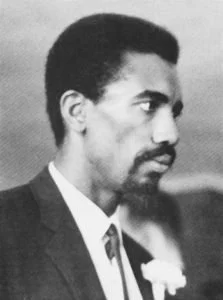
Henry Dumas (1934-1968) was born in Sweet Home, Arkansas, and moved to Harlem at the age of ten. In his short career, he served in the Air Force, taught and advocated for disadvantaged students, and was active in the Civil Rights Movement. Toni Morrison later called him “an absolute genius.” His critically revered poetry and prose is available in Knees of a Natural Man: The Selected Poetry of Henry Dumas (Flood Editions) and Echo Tree: The Collected Short Fiction of Henry Dumas (Coffee House Press). Dumas was killed in New York at age 33 by a transit policeman.