
Edited by Nina Beguš
Reviewed by Austin Todd
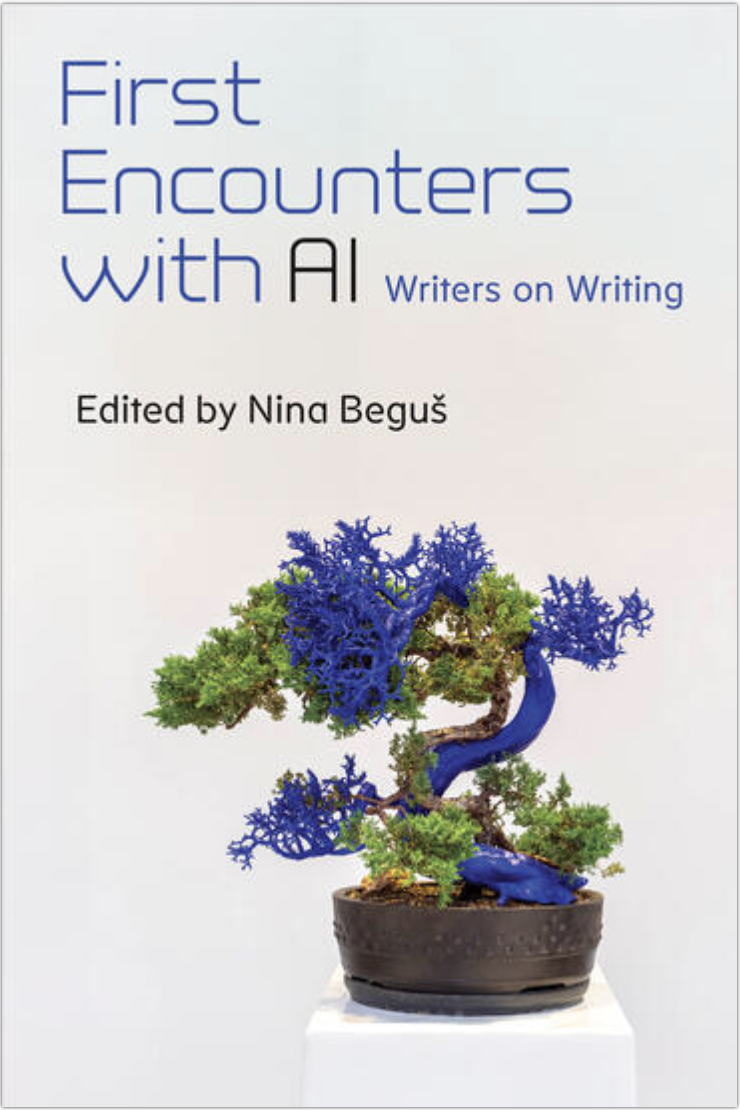
In 1994, Mary Oliver wrote that “in the world of writing, it is originality that is sought out, and praised, while imitation is the sin of sins.” First Encounters with AI is a collection of fifteen essays by writers who grapple with the fact that LLMs, essentially just imitators par excellence, are beginning to produce writing that is not only natural and fluent-sounding, but also, seemingly, original.
True to the book’s advertised aim of answering “What happens to writing when language is no longer used only by humans?” nine of the fifteen contributors investigate different qualities of AI writing. Arguments vary widely: AI writing is architecturally conservative; the density of choice that art requires disqualifies AI; AI writing poses theoretical challenges to the Barthesian “death of the author”; AI may be good at imitative forms of writing; LLMs can write stories but not plots; and, strange AI writing can fascinate or push the boundaries of human imagination.
Yet as you read, it becomes clear that the collection’s writers all conceive of AI somewhat differently. Some, like Allison Parrish, Ken Liu, Ted Chiang, and Hannes Bajohr, understand the technical side well and exploit this understanding in their arguments. They circumscribe AI’s abilities, noting that LLMs do not think, but write using, as Bajohr puts it, “next-token prediction, [...] looking for statistically probable sequences of textual content.” LLMs are “smart jesters, not truth tellers” (Dumit and Con Diaz) which turn human writing into soup, mixed in the largest “gargantuan computational pot” you’ve ever seen, “and then strangers on the internet write peculiar incantations in order to gain access to specific vapors” (Gero).
Meanwhile, other authors doggedly anthropomorphize AI. Sasha Stiles terms AI “synthetic intelligence” and shares the umbrella of the first-person plural: “We are, together, a symbiotic organism [...].” Sheila Heti wonders, “what sort of book would an AI love?” I hold personal disdain for the phrase “advanced reasoning model” (Iain S. Thomas), despite the fact that it is, disappointingly, a technical term for a type of LLM. (IBM’s own site admits that “reasoning models are ultimately just applying sophisticated algorithms to make predictions.” I believe the term is a marketing ploy.)
Of course, to discuss AI’s influence on writing, each writer also ends up forced to define writing itself. The literary-minded note that writing, to paraphrase Le Guin as Liu does, aims “to say in words what cannot be said in words.” Writing is art, thought, and “an act of communication between you and your audience” (Chiang). It requires intention. Conversely, the contributors I feel friction with tend to see writing teleologically and often dip into grammars of science or “deliverables.” For James Yu (entrepreneur and founder of “one of the first AI writing tools for fiction”), “the process of writing is an act of knowing.” Later, former Google engineer Qiufan Chen breathlessly defends literature as “on par with empirical investigation or logical reasoning.”
It is only natural that the diverse group collection editor Nina Beguš brought together would have equally diverse conceptions of writing. However, it is hard to see how “today’s most original literary minds” (per the UMich website) encompasses both Heti, a career author, and Thomas, primarily a “Brand & Creative Leader for the AI Era,” according to his LinkedIn. They are both “writers” in a broad sense, but don’t these two have vastly different amounts at stake?
Besides the essay I described in my notes as “too abstract to even engage with” and the L.A. doomers hoping beyond hope for future AIs that don’t ruthlessly gobble text and writing jobs while precipitating global conflagrations, the collection’s remaining authors consider LLMs in writing classrooms. Two academics write a cautious piece about AI’s potential to help teach scholarly genre conventions, Annelyse Gelman puts Claude through poetry class (mostly for the fireworks), and a few others imagine incorporating AI in writing workshops.
The Mary Oliver quote I started with comes from A Poetry Handbook, her manual for reading and writing poetry. In the quoted passage, Oliver is actually defending imitation, which she sees as a necessary part of any poetry education. Perhaps she would even agree with Stiles, who writes that “all writers, consciously or not, are trained on corpora.” But Oliver would undoubtedly go further. For her, while imitation was crucial, it was not the end, as it is for LLMs. Imitation, she writes, only helped “until some solid grounding in the skill was achieved and the slight but wonderful difference—that made you you and no one else—could assert itself.” First Encounters with AI does show how far LLMs have forayed into the realm of language. It does show creative ways writers have engaged with the technology. But, ultimately, the collection’s truly democratic smattering of articulate AI criticisms and inarticulate AI apologisms will, more than anything else, reassure the skeptical reader that human imitation (in the classroom) and human originality (on the page) have given little ground.